

 Español
Plumber SEO for Urgent Local Calls
A burst pipe at night creates a short, high-pressure search journey. Your site and Google presence need to show the right service, the right area, and a clear way to call before the homeowner moves on.
Plumber SEO is the work of making a plumbing business easier to find and trust in Google Search and Maps for the services and places it genuinely serves. It joins local relevance, fast mobile pages, accurate business information, and proof that a real professional will answer the call.
SparkSEO, a performance-oriented SEO agency in Barcelona, approaches this as a human-first local search problem. The aim is not empty visibility. It is to help a stressed person find useful information and reach the right plumber with confidence.
- Urgent mobile search paths
- Accurate service areas
- Clear click-to-call routes
- Honest trust signals
- Measured local progress
Prefer to talk first? Schedule a call with a personal SEO manager.
Based on 14 active clients with at least 12 months of data. Updated October 2026. See how we measure results
Plumber SEO has to earn the call during an urgent search
The hard part of plumbing SEO is that many prospects do not plan their search. Imagine a homeowner standing beside a leaking boiler at 11 pm. They type “emergency plumber near me” on a phone, scan a few options, and need a safe next step within minutes.
A generic home page makes that choice harder. A focused local search presence makes it clear whether you handle the problem, cover the address, and can be contacted now.
Start with the jobs that create immediate demand, such as burst pipes, blocked drains, leak detection, water-heater faults, and after-hours repair. Each priority service needs a useful page that explains the symptom, the scope of service, what the customer can do safely while waiting, and how to contact the business. This gives people an answer before it asks for a call.
Build the work around the real places you serve, not a long list of copied town pages. Google’s local ranking guidance says local results are mainly based on relevance, distance, and popularity. A page with a truthful service, location context, and contact route helps establish relevance, while distance remains something no page can erase.
This is where local SEO services and the industries we serve meet the plumbing customer journey. SparkSEO can map one keyword group to one landing page, then assess whether the page helps a person understand the service rather than repeating a phrase until it loses meaning.
Make the map result and the website work as one call path
A visible map result can still lose the job if the business details conflict with the website. For example, a profile may say open, while the emergency page gives no after-hours number or the contact link is difficult to use on a small screen.
The solution is one consistent path from the local result to a useful page and a direct, trackable call option.

Complete Business Profile
Use the correct primary category, current hours, phone number, website, and services. Google Business Profile work keeps this information aligned, and Google says complete and accurate information makes a business more likely to show for relevant local searches.

Map Pack relevance
The Map Pack is the group of local results shown in Google Search. Match each main service page to the services and areas you genuinely offer, so the search result and the landing page tell the same story.

Click-to-call clarity
Place a readable phone number and a clear call action near the top of urgent pages. State the service hours honestly, because an unanswered emergency route damages trust at the moment it matters most.
Use service-area pages that describe real coverage and real work
A plumber may cover several districts, but a thin page for every neighborhood can confuse customers and create pages with no distinct value. Picture a company that lists twenty suburbs, then sends every visitor to the same paragraph and contact form.
A better structure starts with the places the team can serve reliably and gives each meaningful page service-specific local detail.
Define the actual coverage area
Confirm the cities, postal codes, or districts where crews take jobs, including after-hours limits. Google’s service-area guidance identifies plumbers as service-area businesses and allows up to 20 service areas.
- Serviceable locations
- After-hours limits
- Travel expectations
Set the profile accurately
A business that does not receive customers at its address should remove that address from its profile. Google also says the overall service area should generally stay within about two hours of driving time from the base.
- Correct business type
- Accurate areas
- No hidden storefront
Create useful local pages
Give a major area page distinct information: the emergency and scheduled services offered there, typical access considerations, proof of coverage, and the next contact step. Do not manufacture local detail that the business cannot support.
- Unique service context
- Relevant proof
- Direct contact route
Connect pages logically
Link between a core emergency page, major service pages, and the appropriate area pages. SparkSEO’s plumber local SEO guide gives the broader framework for building this structure without turning it into a collection of duplicate pages.
- Service hub
- Area relevance
- Helpful internal links
Give mobile visitors enough confidence to call without making unsafe promises
An emergency page often fails because it starts with a slogan instead of the facts a worried homeowner needs. If a customer sees “24 hour help” but cannot see the phone number, service limits, or license information, the message feels risky.
A clear page leads with the job, the coverage, and honest expectations. It reduces friction while respecting the seriousness of water, gas, and property-safety issues.
- Name the urgent problem Use plain service names such as burst pipe repair or emergency leak repair. A short safety note can direct people to the proper emergency service when there is immediate danger.
- Put contact options first Show the call number, available hours, and any genuine alternative contact method near the first screen. Use a descriptive call action rather than a vague button.
- Show coverage honestly State the towns or districts served and any travel or availability boundaries. This prevents a caller from assuming coverage that the business cannot provide.
- Show professional proof Display licenses, insurance, certifications, and warranties only when current and applicable. Link to details or explain the limits when a claim could be misunderstood.
- Keep the page fast and readable Compress heavy images, avoid obstructive pop-ups, and test the contact route on a real phone. Site Speed and Core Web Vitals can help identify the technical barriers that delay an urgent visitor.
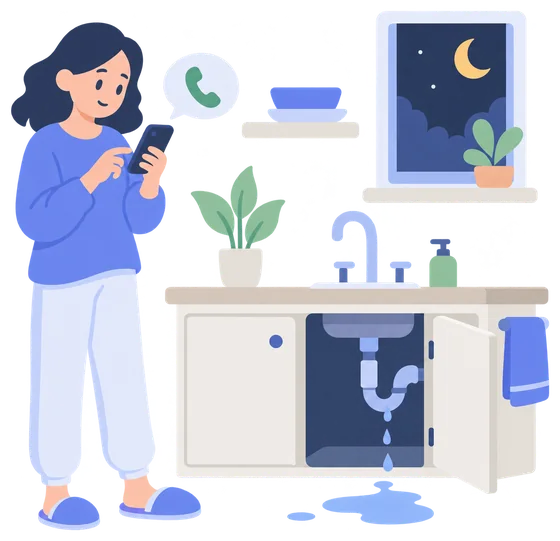
A burst-pipe search journey shows why page structure matters
Urgent queries are broad because the searcher is focused on the problem, not on SEO language. Consider a hypothetical plumbing firm that covers three nearby cities and receives calls for burst pipes after normal hours.
If its profile, emergency page, and service areas disagree, a prospective customer has to guess. A coordinated page structure removes that uncertainty.
Imagine a homeowner searches “emergency plumber near me” after water begins leaking under a kitchen sink. The firm appears with current hours, a matching emergency repair page, an obvious call option, and a clear statement of the cities it covers. The visitor can decide whether the business is a fit before placing the call.
- Use one emergency plumbing page that explains the service and the immediate contact route.
- Link it to the three meaningful service-area pages, each with accurate coverage information.
- Keep the Business Profile hours, phone, and website destination consistent with the emergency page.
- Review call outcomes with the office so that service descriptions and availability remain accurate.
The site becomes easier to understand in a stressful moment. The gain is not a promised ranking or call volume. It is a more relevant route from a local query to a truthful decision, which is the foundation needed before performance can be measured.
Current plumber SEO favors useful evidence over copied location pages
Shortcuts can produce pages quickly, but they do not make a plumbing business more credible. A common example is a group of near-identical city pages that swap only the place name, paired with reviews that sound generic or cannot be verified.
The durable alternative is a small set of accurate pages, real proof of work, and information that helps a customer make a sound choice. This follows Google’s people-first content guidance, which prioritizes content created to benefit people rather than manipulate rankings.
Shortcuts that create risk
- One copied paragraph across every suburb
- Hours and service claims that the office cannot meet
- Keyword repetition instead of problem-solving information
- Bought, filtered, or invented reviews
A people-first local presence
- Distinct pages for meaningful services and areas
- Current hours, contact details, licenses, and insurance
- Photos and explanations that show how the business works
- Genuine review requests and respectful responses
Reviews, work photos, and honest credentials help a customer choose safely
Plumbing problems can affect a home’s safety and finances, so a visitor has good reason to question unfamiliar businesses. A gallery of stock images and an unqualified claim of being the best provide little help when the customer needs to choose someone to enter their home.
Trust is built through evidence that is specific, current, and easy to check.
Use photos that accurately show the team, vehicles, completed work, or equipment when customer privacy permits. Include concise captions that explain the service, not a list of search terms. Google says photos and videos can show customers what a business offers and tell its story in its local ranking guidance.
Ask every eligible customer for an honest review through the same simple process. Respond calmly to useful feedback, including criticism where a response can clarify next steps. Google says positive reviews and helpful replies can help a business stand out, but the aim should be better customer information rather than rating manipulation.
Do not buy reviews, condition an incentive on a positive opinion, or hide negative feedback. The FTC’s final rule on fake reviews prohibits purchasing fake or false consumer reviews and prohibits compensation tied to a particular review sentiment. That legal and reputational risk is not a sensible trade for short-term visibility.
Check the proof that supports each high-intent plumbing page
A page may rank for a relevant plumbing query and still leave the visitor uncertain. For instance, an emergency drain page may list a phone number but omit who will attend, where the firm works, or whether it carries insurance.
A short trust audit keeps important proof visible and prevents marketing claims from drifting away from operational reality.
| Signal | What the visitor needs to see | How to keep it accurate |
|---|---|---|
| Business identity | The real trading name, phone number, and service contact | Match the website, invoices, and Business Profile |
| Coverage | Cities or districts the team can actually reach | Review areas when crews or availability change |
| Credentials | Applicable license, insurance, and certification details | Confirm validity and explain scope before publishing |
| Emergency availability | Current hours and the correct contact route | Update the page whenever on-call cover changes |
| Work evidence | Relevant, privacy-respecting job photos and customer feedback | Request genuine reviews and reply with care |
Google’s Business Profile guidelines say businesses should reflect their real-world representation, keep the address or service area accurate, and choose the fewest categories needed to describe the core business.
Use these guides to plan a practical plumbing SEO programme
Plumbing SEO involves local operations, content, technical checks, and reporting. A single tactic, such as adding city names to headings, cannot solve every issue for a service-area business.
These resources explain the components in more detail and help place each improvement in a sensible order.

Local SEO for plumbers guide
Read SparkSEO’s detailed guide to the local SEO work that supports plumbing search visibility, from business information to useful local pages.
Read moreNear me search guide
Learn how location pages can serve “near me” intent with useful local information instead of copy-and-paste place names.
Read moreGoogle Business Profile service
See how accurate categories, services, hours, photos, and reviews support a trustworthy presence in Search and Maps.
Read more
SEO audit service
Review content, technical obstacles, and local competitor patterns before deciding which plumbing pages deserve priority.
Read moreQuestions about plumber SEO
What is plumber SEO?
Plumber SEO is the work of improving how a plumbing business is understood and found in search results for relevant services and locations. It includes useful service pages, accurate Business Profile information, technically sound mobile pages, genuine reviews, and clear contact routes.
Can plumber SEO help an emergency plumber near me search?
It can make the business easier to understand for relevant local searches by aligning emergency service pages, coverage information, and Business Profile details. It cannot remove the role of a searcher’s location or guarantee a specific ranking, because Google says local results also depend on distance and prominence.
Should a plumbing company create a page for every nearby town?
No. Prioritize pages for real, meaningful service areas and give each page distinct information that helps a local customer. Copied location pages add little value and can create a confusing experience when the business does not truly cover the area.
How should a plumber use Google reviews?
Ask customers for honest feedback through a consistent process and respond professionally when a response is useful. Do not buy reviews or reward only positive opinions, because authenticity matters to customers and review rules prohibit deceptive practices.
What trust signals belong on an emergency plumbing page?
Include the real business name, current phone number, stated service hours, truthful coverage area, and applicable license or insurance information. Relevant work photos and genuine reviews can add context, but claims should never exceed what the business can verify.
How does SparkSEO measure plumbing SEO work?
SparkSEO measures non-branded keyword progress each month by landing page and approved keyword group. Reports cover position and SERP changes as well as completed work, so the discussion can connect search progress with useful improvements to pages, technical health, and local visibility.
Sources
- Google Business Profile Help: Tips to improve your local ranking on Google
- Google Business Profile Help: Manage your service areas for service-area and hybrid businesses
- Google Business Profile Help: Guidelines for representing your business on Google
- Google Search Central: Creating helpful, reliable, people-first content
- Federal Trade Commission: Final Rule Banning Fake Reviews and Testimonials
Get Your Free SEO Plan and Price
Share your website and your personal SEO manager will review it. You receive a plan with priorities, the keyword groups we would target first and a price that follows your non-branded rankings.
- Monthly billing. Cancel at any time and keep every result you paid for.
- A personal SEO manager who is online during Barcelona working hours.
- Weekly and monthly reports measured per landing page on non-branded keywords.