

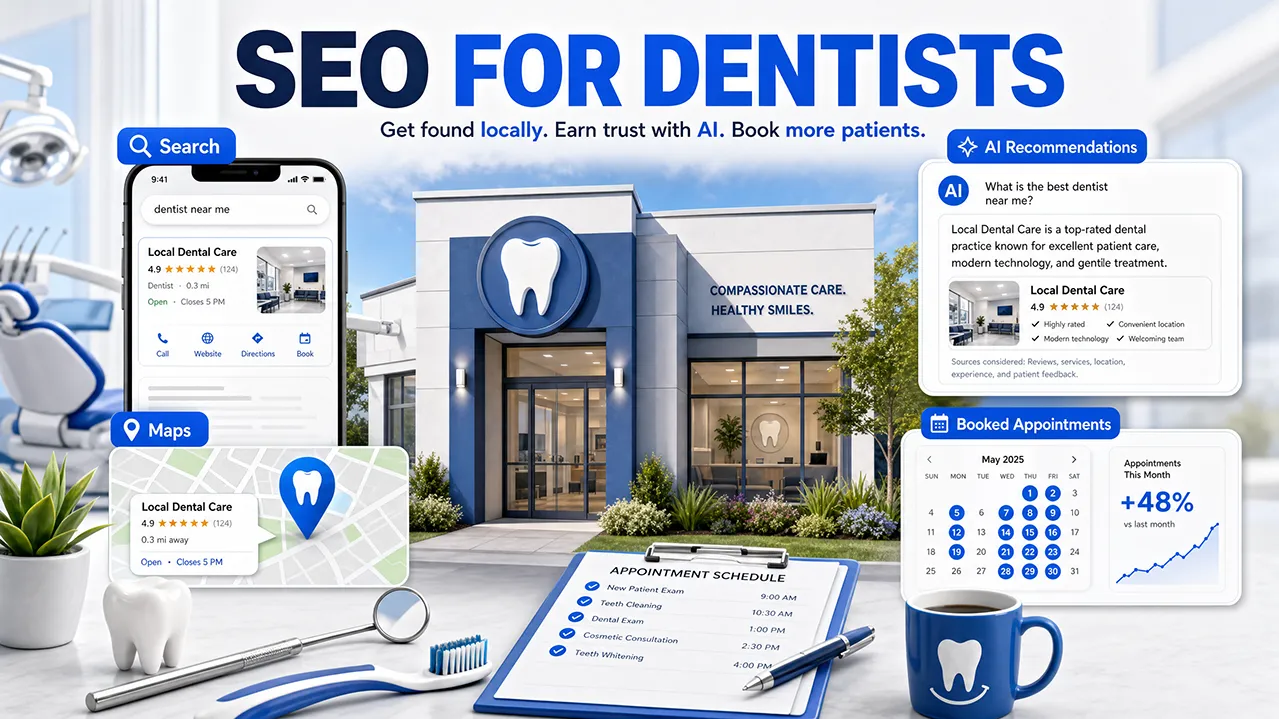
Depending on the area that your surgery is based in, dentistry can be an incredibly competitive game. That means that appearing near the top of your patients’ search results could mean the difference between appointments being booked months in advance and waiting for the phone to ring.
With somewhere north of 53% of all web traffic starting with a search or AI recommendation, and 97% of clicks going to sites listed on the first page of results, SEO matters.
How Should Dentists Plan Their SEO Strategy?
For the vast majority of dentists, their patient lists will be made up of people who live relatively close to their practice. There are exceptions to this, such as specialists who may take referrals from further afield, but for most dentists, the focus should be squarely on local SEO.
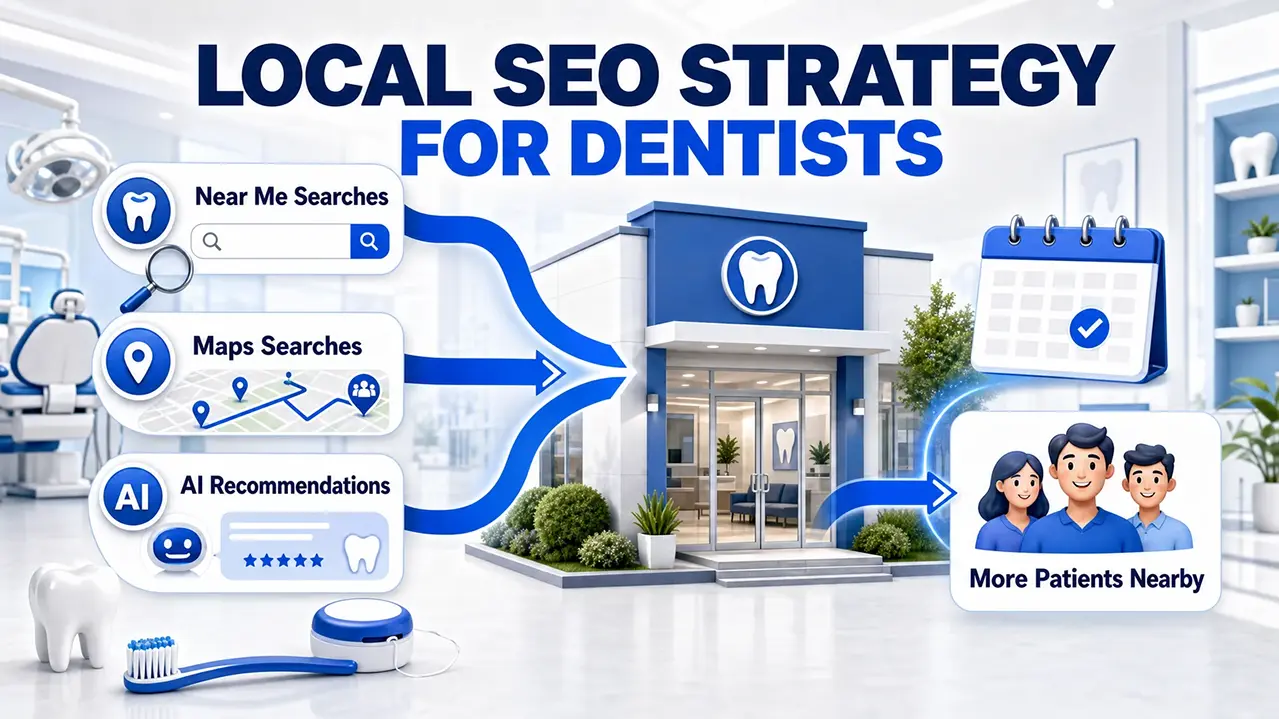
There are three areas that we can focus on to help improve our rankings for these potential clients:
- “Near Me” searches- these should be your primary target, and you can rank here in a number of ways.
- Maps Searches- appearing in the “map pack” is fantastic for any locally based business, especially in-person services like dentistry.
- AI citations and Recommendations- around 60% of searchers find everything they need in an AI search recommendation, and Chats with AIs are becoming a more and more common way to find services.
In the early days of the internet, ranking well locally was simply a matter of stuffing relevant keywords into your site wherever possible. Today, things are far more complex, and all your efforts are interlinked. There’s a lot of overlap (such as the impact of Google Business Profile), but each type of local SEO requires its own touch to get the most out of your efforts.
Your SEO plan should aim to take in all of these types of searches. As dentistry is part of the health industry, Google and other search engines place stricter criteria (known as Your Money or Your Life) for ranking, so your efforts need careful consideration.
Google Business Profile for Dentists
Google Business Profile is a free tool from Google that plays an outsized role in almost all local SEO. Its primary purpose is to allow you to appear on Maps, but it’s also used as a source for AI recommendations, which means that you can appear in the “places” section at the top of “near me searches”.
Setting up your GBP can be done, even if you don’t have a dedicated website, and optimizing it so that you appear in the “Map Pack” (the top 3 results) can help to bring in 93% more contacts than those who appear in the 4-10 position.
Getting the Most from Your Google Business Profile
The first step towards ranking is simple: claim and verify your Google Business Profile. With this step done, you’ll start to appear in the various types of search that we’re targeting, but to start to climb the rankings, we’ll need an understanding of how they work.
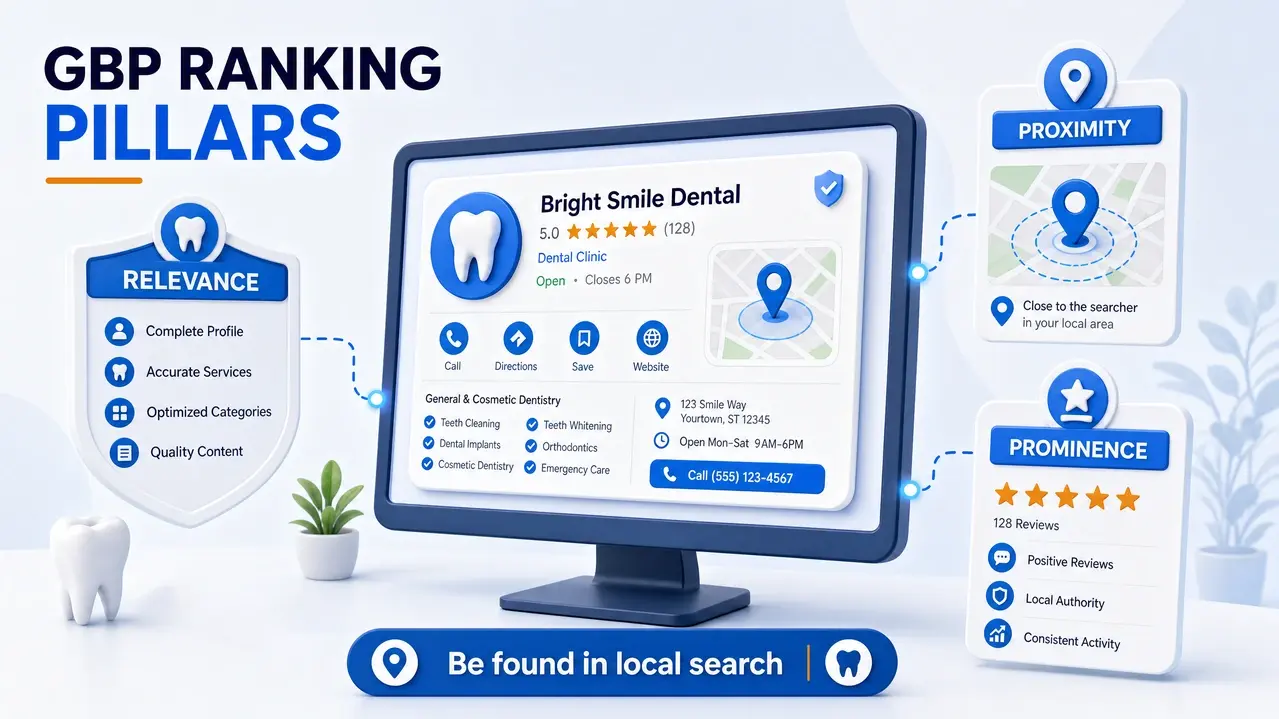
Google Business Profiles use three pillars when determining what is a “good” result to offer.
- Relevance: how well optimized your profile is for a certain search. We’ve actually got quite a lot of control over this.
- Proximity: how close the person searching is to your location when they search for a dentist. We’ve got some influence over this via setting up our service areas, but ultimately, you can’t control where people search from.
- Prominence: how popular your business is. This is determined through a few different factors, some of which we can influence.
There are also behavioural factors relating to how people interact with your profile, but these are best influenced through the same methods as relevance, so we’ll cover them there.
Building Relevance
The area of your GBP ranking that we have the most direct control over is relevance. This is basically how closely the content relates to a search term or AI query, and it takes into account pretty much all the content.
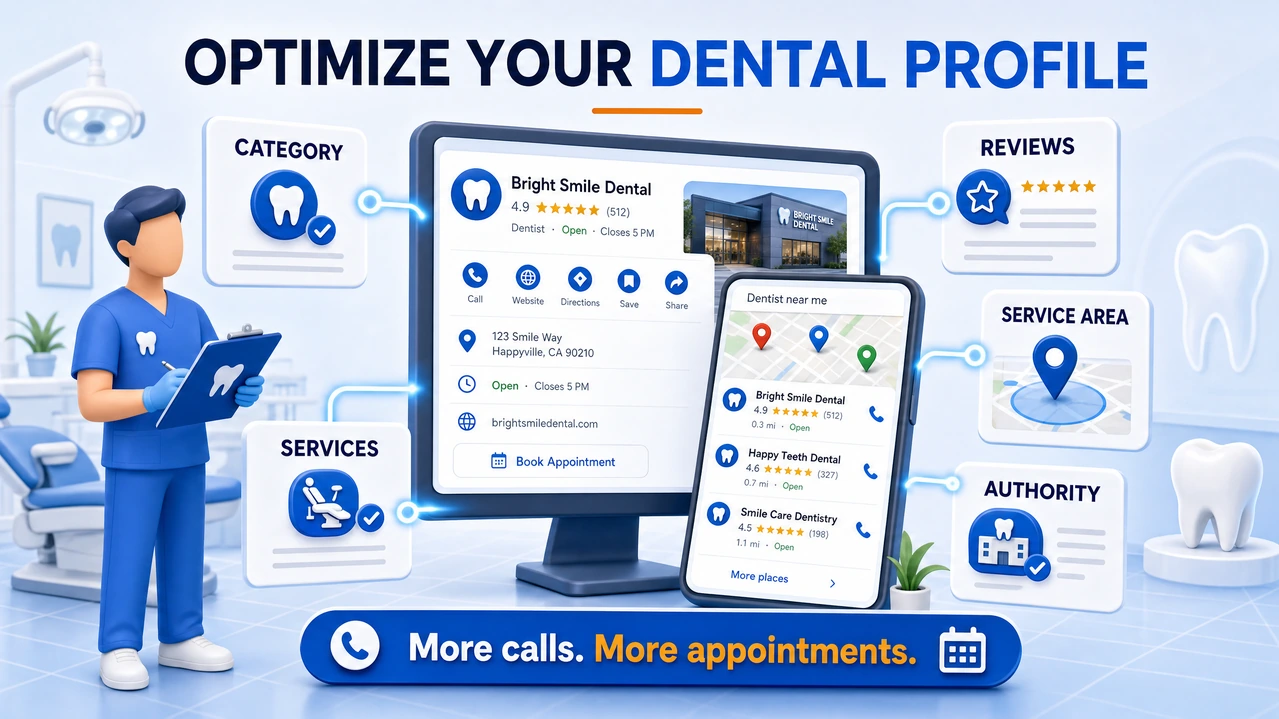
The first step is to simply select your primary category. In our case, unsurprisingly, this is “dentist”. If your practice is more specialist, you can then set a secondary category like “cosmetic”, “clinic”, or “orthodontist” as appropriate. This is the primary signal that you can send that your business matches with anyone looking for a dentist.
The next step is filling out your business profile. List all your services, remembering that patients might use various terms to describe the same service. For example, you might list both “cleaning” and “whitening”.
Along the same lines as listing your services, you should take a little time to craft your business description. This is a fantastic place to build relevance through relevant keywords like “painless extraction” or “veneers”, though you should resist the urge to overstuff them- it must read naturally for both Google’s bots and your customers.
Dealing With Reviews
Another feature of Google Business Profiles that plays a role in both prominence and relevance is your reviews. These allow your patients to recommend your services directly, and they’re used by 96% of searchers when making their choices.
In terms of using them to build relevance, the wording of reviews is important. These keywords directly contribute to relevance scores, so reaching out to customers directly and asking them to be specific in their reviews can be very helpful.
In terms of prominence, a slow and steady trickle of reviews demonstrates an established business with happy customers. Sudden spikes in the number may seem suspicious and incur penalties or even have your account suspended, as they may suggest that you are gaming the system.
Answering reviews, even if they’re negative, is another important task. Google prioritizes actively managed profiles over those that are ignored, and replying is an easy way to meet this criterion. Always be polite and professional in your responses, as this is often the first contact a new potential client will have with you.
Dealing with Proximity
GBP rankings take into account the location from which someone is searching when deciding how to rank their results. This isn’t simply a matter of the closest business in the category being the top result, as other factors come into play, but it is a major consideration.
Now, obviously, we can’t control how close someone is when they type “dentist” into Google Maps, but we can target our desired customers by setting our service area when setting up our GBP.
Set this as wide or as tight as your capacity for patients will allow. The general rule is that the bigger the area, the more potential customers, but this has to be balanced with how many other dentists operate within the larger area.
Building Prominence
Prominence is a measure of your business's reputation and activity. The main drivers here are your reviews (which we’ve already covered), but how your practice appears elsewhere on the internet is also taken into account.
Building links with local and national bodies, like the BDA or the local equivalent, sends clear signals that you’re a prominent part of the dental industry. Likewise, local listings on directory sites and local authority or health board lists can provide incredibly useful backlinks for both your GBP and more general local SEO.
Local SEO for Dentists
Once your Google Business Profile is up and running, the next area to focus on is how you appear in traditional “near me” searches. These are the “dentist near me”, “dentist accepting new patients”, “NHS Dentist” searches that people directly ask Google, other search engines and their favorite AIs.
The top three results account for 75% of all organic traffic from search results pages, so putting time and effort into your content is worthwhile. With only around 63% of small businesses investing directly in local SEO, getting results isn’t always as hard as you might imagine.
There are numerous things that are taken into account when determining your ranking, and for businesses like dentists' surgeries that cover health matters, the rules are, not unreasonably, applied even more strictly than they are for less sensitive industries.
How Are Sites Ranked?
The basic thing that all search engines and AIs have in common is that they want to offer the best, most relevant results to their users. Each has its own way of determining this, placing emphasis on slightly different things, but they generally determine the quality of a result through what we call EEAT.
EEAT- Expertise, Experience, Authority, Trustworthiness- is the set of criteria that all the content online is graded through before it’s offered up as a search result. Each page will have its own score in each of these areas, but how they’re linked to each other (and other information online) also plays a significant role.
Building Authority
Authority is the metric that search engines and AIs use to evaluate how reliable the information that you’re offering is. This is done in a few different ways, but the two most important are related to links:
- Out-Going Links: These are the links scattered through your content that point to other sites. We’ll go into how to make the most of these in a later section, but the general idea is that they act as references for your claims. They’re free, and you have complete control over what is linked.
- In-Coming Links: Also called ‘backlinks’, these act as citations and endorsements of your content. These can be earned naturally, or you could engage in content marketing and have them hosted by a high-quality, relevant site, which gives control but also often comes at a cost.
As dentistry falls under the Your Money or Your Life heading, the quality of these links matters far more than the quantity. A few well-considered links will be worth more to your SEO efforts than dozens of lower-quality ones. This is especially true in the age of AI search.
Backlinks should always be from the best quality sources available. As we’re thinking in terms of local SEO, local licensing boards, professional associations, health boards and local directories are invaluable. These reinforce your authority and place your practice squarely within the local community.
Outgoing links allow you to back up the content of your blogs, building authority through offering more information to your readers. Try to pick sites which are already high-authority and rank well, as these will transfer a little of their score to your own content.
Building Expertise, Experience and Trust
Again, because dentists fall under the banner of Your Money or Your Life, the expectations around expertise, experience and trust are higher than they might be for other businesses. We build these elements of our SEO strategy by writing content that demonstrates them to search engines, AI crawlers and human readers alike.
All your content should be crafted with these three pillars in mind, and the best approach to demonstrate expertise and experience while building trust is to have a registered dentist write (or co-write) your content, using the byline to link to their relevant qualifications. This is true for both landing pages and blogs.
Regardless of the content type, the first thing to consider is how it reads. You want it to be clear, readable and transparent. This makes your information easy to parse for humans and bots alike, allowing them to more easily judge the relevance of your content to a query.
Types of Content
While every aspect of your site and wider online presence plays some role in your local SEO efforts, the two most important types of content are blogs and landing pages.
Blogs
Blogs are your chance to build authority on a topic. These should explore the subject in some depth and be fairly specialized. They can be used to target potential patients who are still considering their options, making them particularly useful for dentists who offer a lot of cosmetic procedures, though every site (regardless of industry) can make great use of them. These are your best chances to be picked up and recommended by AIs.
They can also be used to spread authority to your landing pages by linking between them. This offers readers a chance to really delve into a topic and demonstrates to AI and search engines that you know what you’re talking about.
Landing Pages
Landing pages, on the other hand, are more directly “salesy”. These are generally shorter and target people who are looking for a dentist right away. Each of these should cover a particular type of service, though you may get some mileage out of things like “Registering New Patients Now” or similar general pages.
These should describe the service in some detail, focusing on getting people to make contact and book an appointment.
Localizing Your Content
As this is local SEO that we’re thinking about, your content should be localized. In the field of dentistry, this means simply naming your service area relatively often. This might be most naturally put in the form of things like “Edinburgh's only all-on-4 clinic” or “Crowns and cosmetic dentistry for the Downtown Community”.
While it’s important to mention your location in your services, be wary of overstuffing it. Having too many repetitions in a single blog or landing page will look like keyword stuffing and might trigger penalties on your ranking for overoptimization.
The key here is that all your texts need to primarily read naturally to real people. You wouldn’t mention your office location 3 times in an average conversation, so you shouldn’t do it when writing either.
Designing For Mobile
With around 60% of local searches being done via someone’s phone, designing your site around these visits makes life easier for your potential patients. In turn, this helps keep your bounce rate healthy, improving your SEO efforts through engagement.
A mobile-friendly site is simple to navigate, loads quickly and doesn’t rely on too many images, which would slow the user experience. Keep things clean and write in short, punchy paragraphs and sentences. Include quality-of-life plugins like a call-now button.
Responsive web design allows you to change how your site appears on various devices, but if you have to choose one, choose mobile.
Off-Page SEO
As well as the content itself, there are a couple of things we can do to really hammer home the fact that you are a respected local business and your blogs and landing pages are good results to serve up.
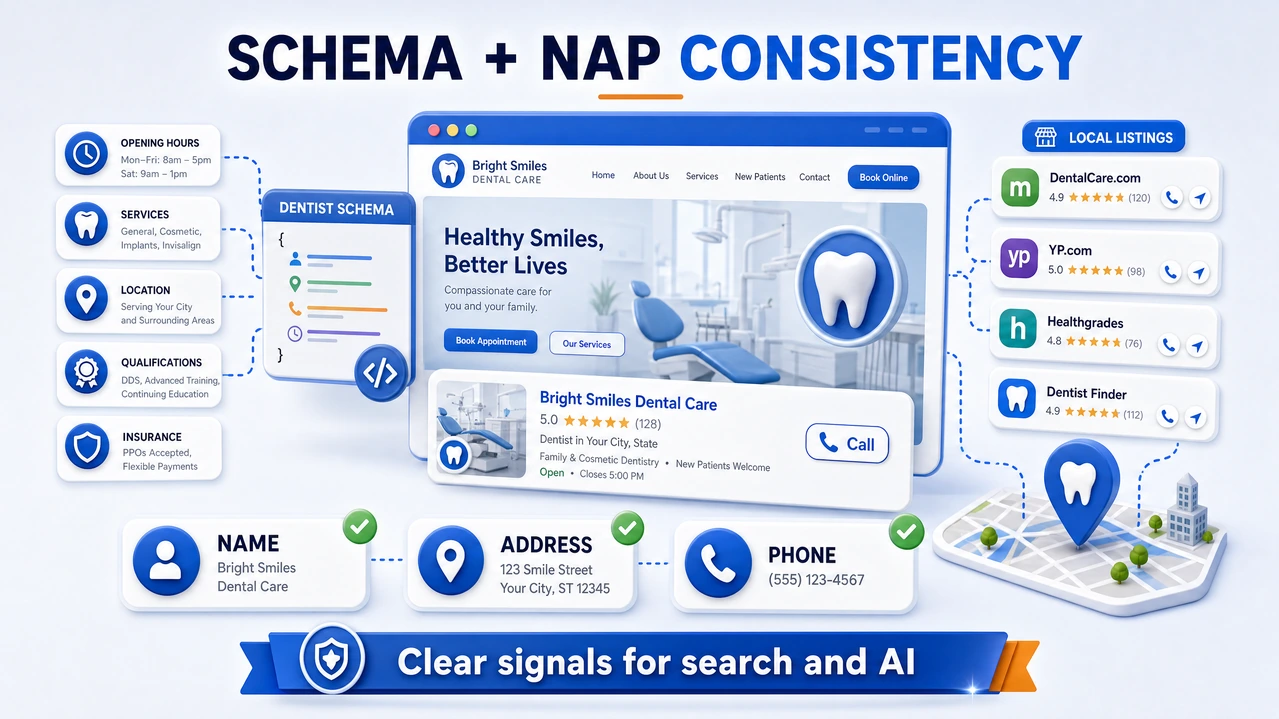
Schema Markup
Schema Markup is a family of simple codes that search engines and AIs can read, telling them various relevant things about your practice. The most obvious version to use is Dentist. It includes (but is in no way limited to) things like:
- Opening Hours
- Price Ranges
- Services offered
- Location
- Team Member Qualifications
- Which Insurance Networks You Cover
These codes sit in the HTML of your pages and allow search engines to create what we call “rich snippets”. These allow your page to appear in search results with more information, presented in carousels, call buttons and other non-textual elements. You can test your code to see how it will display with this handy tool from Google.
Schema also helps AI to understand your business and what you offer, making you a more tempting choice for citations and mentions. It won’t guarantee that the chatbots will speak about you, but it does make it more likely.
Listing Locally
Listing your clinic on local directories plays a few roles in helping your local SEO strategy. Firstly, it’s a backlink and will lend a little authority to your site. They also reinforce your Name, Address, Phone Number (NAP), and they serve as a powerful signal of locality.
Listing on general local business directories is great, but as a dentist, there are a few other potential places that could be even more useful. Many local authorities will have lists of local health services, as will doctors' surgeries, hospitals and other health-related institutions. These will not only reinforce your locality, but they’ll also offer particularly strong boosts to your authority.
Name, Address, Phone Number
The whole point of building a local SEO strategy is to get your contact details in front of your potential patients. We call these details your NAP (name, address, phone number), but they also include things like WhatsApp contacts, emails and any other way they have to get in touch and book an appointment.
These details must be consistent across every place that they’re mentioned. That means ensuring that every directory listing, social media page, and your site is exactly the same. Any differences could result in search engines, AIs, or, worse, your patients becoming confused.
What Are Good Sources Of Backlinks for Dentists?
As we covered briefly in the previous section, backlinks are a primary source of authority for your blogs, landing pages and your site in general. These links from other sites that point to yours act as endorsements and let search engines and AI know that your content is good.
Some of these will be earned naturally as people write content and link to you. Others you can insert into content you write for other pages (what we call content marketing).
The first, and most important thing to realise is that quality matters. Backlinks must come primarily from high-authority, relevant sites. Since 2012’s update to Google’s algorithms, this has been true for all businesses, but it’s especially important for health-related industries. Where your site is mentioned sends signals about topical relevance and authority to search engines and AIs.
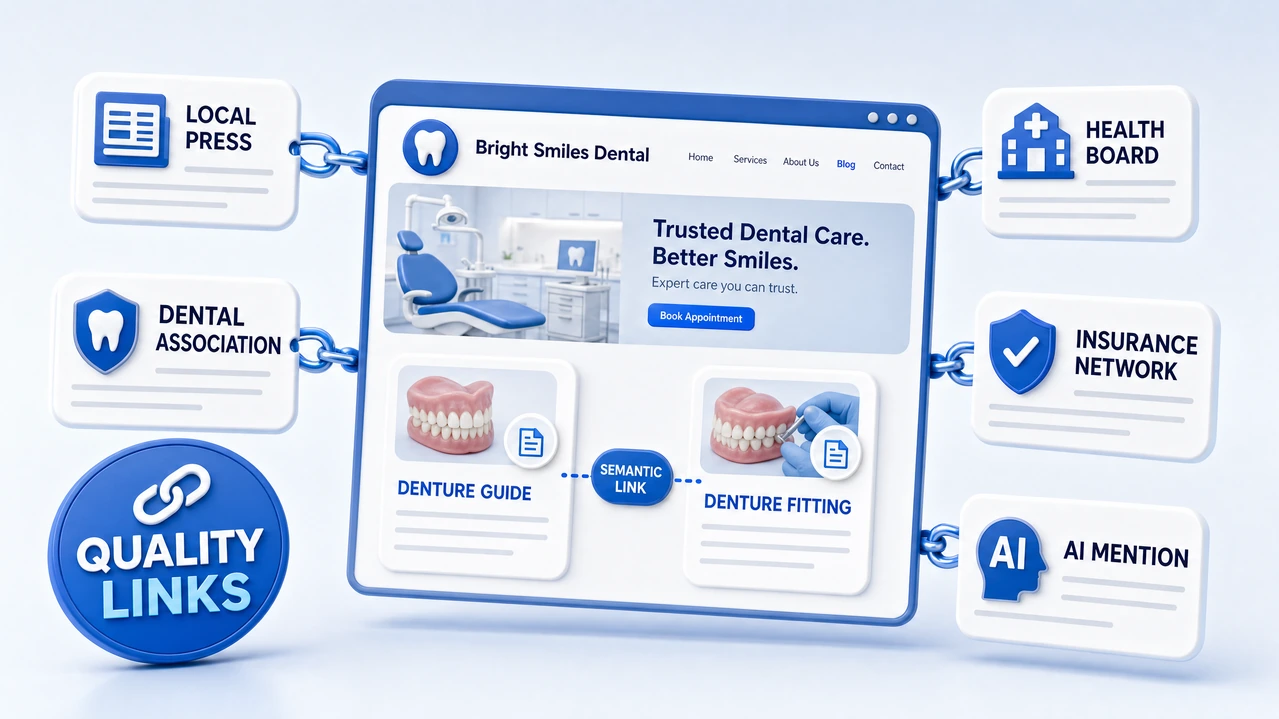
There are two useful types of backlinks for any dentist: local backlinks that reinforce your location, and topical backlinks that signal your position as a dentist.
Local Backlinks
Local backlinks are generally fairly easy to come by. The most obvious source of these are local listings in directories and lists of approved healthcare providers. Other high-quality sources might come from local press, charities and other respected institutions.
If you’re involved in your local community, think about sponsoring events and asking for a link in return. You could also offer quotes to local journalists, bloggers and other media if an appropriate story comes up.
Topical Backlinks
For businesses in the Your Money or Your Life category, topical authority plays an absolutely huge role in how well your site will rank on search engines and how likely it is to be picked up by AI. The easiest way to build this authority is through being mentioned by high-quality, relevant sites.
Topical backlinks might come from national associations, network insurance providers or other relevant dentistry-related sites. As well as basic listings, reach out and offer to write a blog on a relevant topic, linking to your associated landing page.
Not only will these links boost your page’s authority considerably, they can generate a surprising amount of traffic in and of themselves.
Building Backlinks for AI
Quality always matters when choosing where you want your backlinks to come from, but with the rise of AI search and chatbot recommendations, it’s even more important than ever. Once upon a time, simply having a lot of links pointed towards your content was enough to ensure ranking, but that is no longer the case.
While you can’t stop sites from linking to your content, it’s important to think about how the links we do choose signal authority and relevance to AIs that might mention us. It’s more important to ensure that the content linking to you is genuinely related to your link than it is to fuss over the exact wording that you highlight. This is known as “semantic linking”.
This means that context is more important to AI results than matching keywords exactly in your anchors. For example, if you’re writing a blog on the process of creating false teeth, you should link to your denture fitting landing page rather than your home page, as this offers far better semantic linking.
It’s worth running a few questions through the various chatbots and paying attention to which sites they already recommend. These will already have been mapped and deemed to be high-quality. If you can get content on them to mention you, your chances of being mentioned in return are much higher.
Picking Keywords For Dentists’ Websites
Keywords are the most basic element of SEO- they’re the signals that tell search engines and AIs what your content is actually about. These are what users put into the search bar when they ask their questions.
In the early days of the internet, simply having the relevant phrase in your text more often than your competitors was enough to ensure you ranked higher than they did. Today, that is not the case, and things are considerably more complex.
Keywords should be scattered through all your content, and while it’s often useful to match a search term exactly, it’s far more important that the text reads naturally. Simply repeating the same phrasing over and over will likely trigger overoptimization signals and see your ranking drop rather than rise.
Researching Keywords
The first stage of picking your keywords is to simply sit and think about what terms you’d like to rank for. These are the things that people will be searching for when you want them to find you. In the case of a dentist’s office, that might be “yearly checkup”, “crown fitting”, or something similar.
You could then turn to your search engine of choice and see how your competitors have used keywords and what kind of results they’re getting. Alternatively, you could use a simple tool and get much more detailed information.
Competition vs Difficulty vs Volume
It goes without saying that you want to rank as highly as possible in as many relevant searches as you can- that’s the whole point of constructing an SEO strategy, after all. That being said, there is a little nuance to consider here.
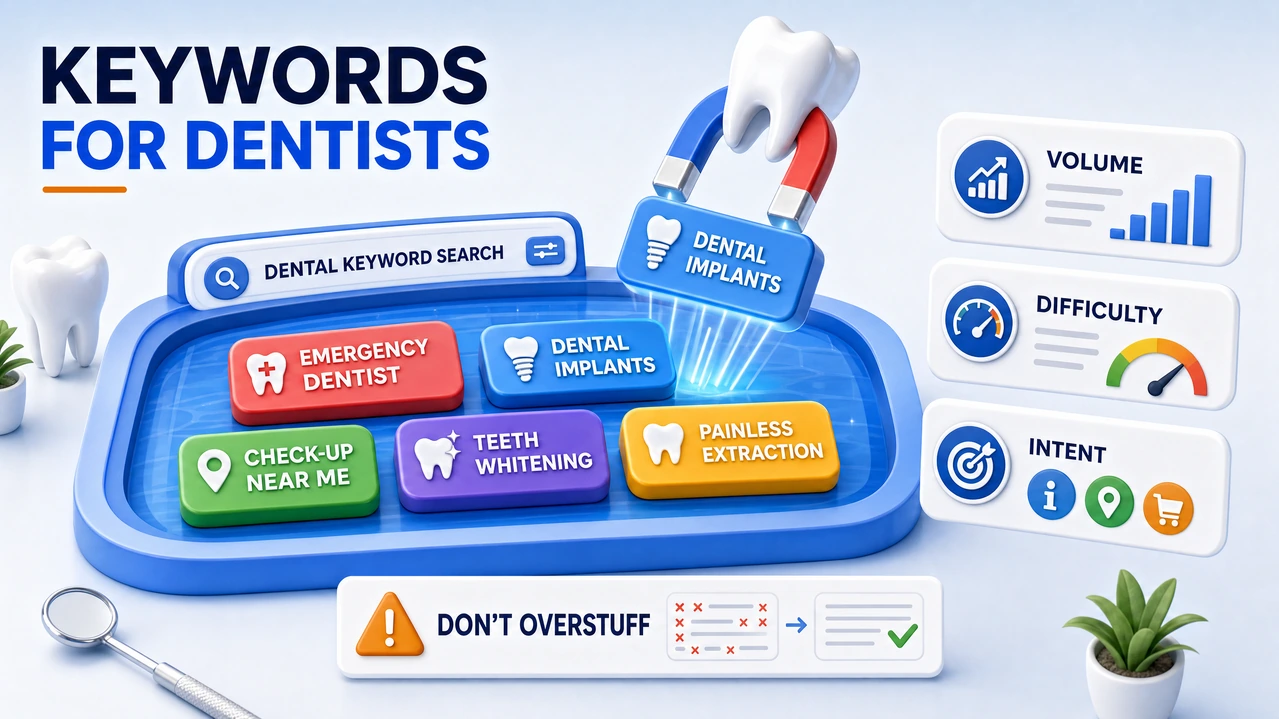
There are three key metrics that a keyword research tool can give you:
- Volume: The (estimated) total number of searches for that term
- Competition: How many sites are targeting that particular term
- Difficulty: the average authority score of your competitors around that term
Ideally, we’re looking for keywords that are high-volume but low competition/difficulty. More often than not, this isn’t going to be possible, and we’ll have to compromise with an alternative. It’s often more valuable to find a slightly lower-volume but easier to rank for keyword than to waste time chasing the ideal.
Around 70% of all clicks from search engines go to the first 3 results, so finding keywords that we can rank for, even if they’re not the most obvious, can often offer a better return on investment than throwing everything at the highest volume.
While “dentist” is obviously going to be a necessary keyword, it’s also likely to be highly competitive and high-difficulty, making getting the top spot harder. It may be worth targeting more specalized keywords like “dental cleaning” or “implant clinic” and drawing in traffic through more precise searches.
A couple of notable exceptions to this rule are things like “emergency” and “dentist open now”. These are all high-volume searches that, while dificult, are well worth competing for, thanks to the urgency that anyone searching those terms will be feeling.
How To Deploy Keywords In Your Content
Keywords should be scattered through all the content that you want people to find via search engines or AI interactions. There’s an art to balancing using them often enough to send the desired signal without crossing the line into repetitiveness and overoptimization, but they’re by far your best tool for targeting search intents.
Some searchers might be looking to make an appointment or to sign up that day, and they can be best targeted via landing pages and keywords like “emergency appointments” or “accepting new patients”. These can often benefit from being localized by naming your location.
Others might be looking for more general information or weighing up their options for an elective procedure. These can be directed towards your blogs by including less urgent keywords discussing the topic at hand. There’s less need to localize these, though if the opportunity presents itself, you should take it.
Other Keyword Considerations
Keywords are more complex than they once were, and just putting “Chicago Dentist” on your page and leaving it at that will not get you any results at all. A modern keyword strategy takes into account a lot more than simply matching a particular search term.
Semantic Linking
Both AIs and search engines group keywords together into broader categories of linked terminology. We call this latent semantic indexing or LSI, and it means that everything related to a search term or question will be linked.
In practical terms, this might mean that “dental implant” will be linked to “crowns”, “cosmetic dentistry” and “all-on-4 implants”. We can use these links in a few ways to enhance our SEO efforts and improve the quality of our content.
Firstly, it’s important to remember that, even when you’re writing for SEO purposes, humans are your primary audience. Simply repeating the same words over and over is not compelling writing and will put people off.
People who click away from your content quickly will impact your bounce rate and, in turn, drop your ranking. Semantic linking allows you to vary your wording, making it more interesting to read. It also means that you might capture more searches than you otherwise would, as people may not use the ‘proper’ terminology.
This also means that you can avoid incurring penalties from search engines for appearing “spammy” and like you’re simply trying to stuff as many keywords into one page as possible.
Secondly, using a variety of semantically linked keywords in your content makes it easier for search engines and AIs to get a sense of what you’re really saying. This means that they can be more certain that your content is worth offering up in their results.
LSI keywords are important for search engines, but they’re even more so for AI results. They allow a deeper understanding of the meaning of your content, meaning that AIs will place a lot more emphasis on them when constructing their answers to a query.
Longtail Keywords
Keywords don’t have to be a single word; it’s often worth purposefully targeting longer, more conversational phrases in your content. These “longtail” keywords are particularly useful for targeting the more naturalistic terms people use when talking to AIs and voice assistants.
In practical terms, we could incorporate phrases like “Atlanta based dentists office, specializing in white fillings and painless operations”. This longtail keyword would allow us to capture searches for:
- Atlanta Dentist
- Dentist's office near me
- White fillings
- Painless dentists
- Dental operations
These are all likely to be “high intent” searches, making them a valuable thing for any dentist to capture.
Don’t Try to Overstuff
Keywords are best deployed sparingly- it’s better to ensure that a given piece of content ranks well for its main target than it is to try and fit everything into a single page. This means that you’ll have to create more landing pages and blogs, but each is more likely to get the desired results.
There are a few reasons that picking a couple of keywords per page is the best strategy:
- Customers Have Specific Questions. Someone with a toothache doesn’t want to read through 2000 words on picking the best toothpaste. They want information about how to book an emergency appointment, and they probably want it now.
- Search Engines Don’t Like It. Overstuffing sends signals that you’re trying to game the system and will punish you for it. Putting too many keywords into a single piece of content will often result in lower rankings rather than higher.
- Getting The Right Traffic. Similarly to the first point, people turn to the internet with a specific desire. If they’re presented with irrelevant information, they’ll look elsewhere, harming your bounce rate.
Keywords for AI Mentions
AI and traditional search engines treat keywords a little differently from one another. While everything covered in the previous sections still applies, AI places a lot more emphasis on meaning than it does on exactly matching a particular search term.
There are two ways that AI could mention your business: a citation or a mention. A citation is when it uses your content as a reference for one of its answers. A mention is more likely to happen when someone asks for a direct recommendation.
The exact keywords are less important than actually answering questions when it comes to AI citations. This means that, by providing a ready-to-go answer to a question, the AI can confidently present this to its user in a natural and conversational way.
While you’ll still need the target phrase (or a closely semantically linked one), the quality of the answer is far more important than guessing the exact wording.
How Should You Write Content for a Dentist’s Site?
Writing content with local SEO in mind means focusing mainly on two types of pages: landing pages and blogs. Each serves a slightly different purpose in terms of what they offer to your patients and which searches they’re best suited to targeting.
Landing Pages
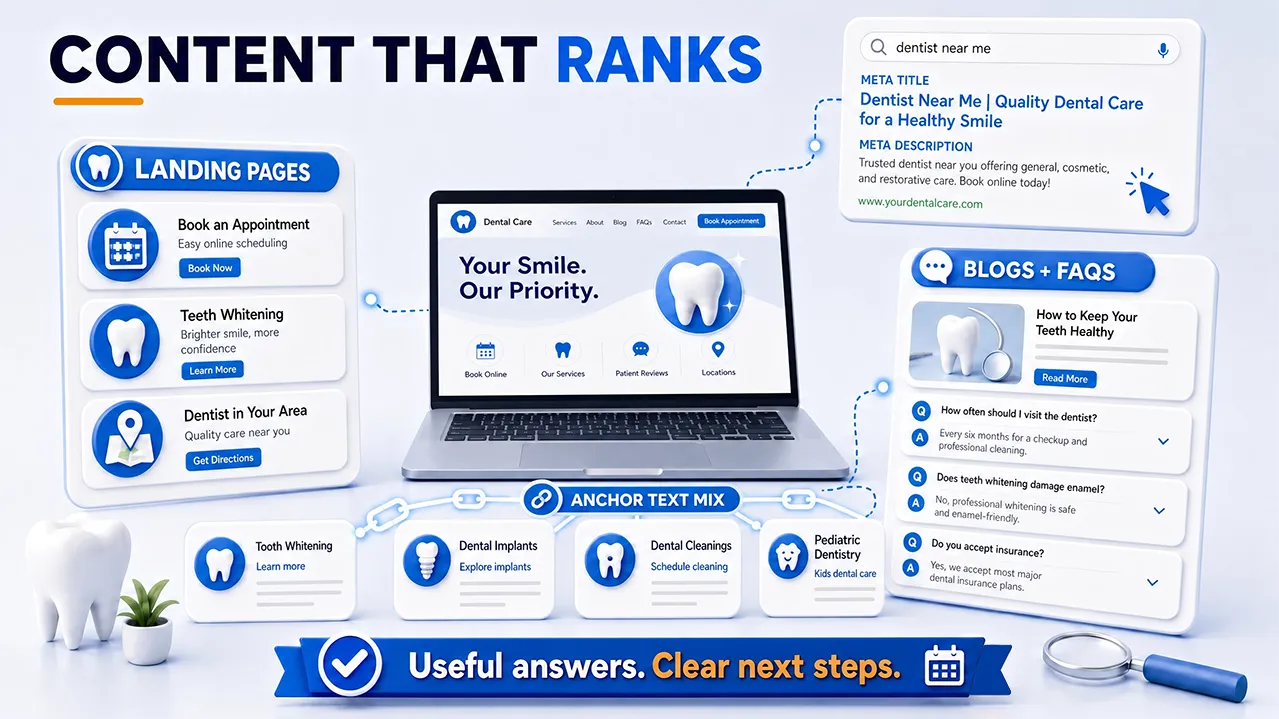
Landing pages, as we’ve already mentioned, are you directly “salesy” content. They’re there to capture “high intent” searches, such as people looking for a specific treatment or a new general practice to join. Each service you offer should have its own page so that you can target it more accurately.
Generally, the copy here should be short, punchy and precise. You’re aiming to offer a solution to people who have a problem with their teeth. Include as many relevant details as you can- things like price ranges, reviews of that treatment and other information that might persuade someone that you are the best choice.
Blogs
Blogs are more general interest. They allow you to explore a topic in a little depth and, in terms of SEO, build a lot of topical authority. This authority can be loaned to your landing pages (helping their rankings) by deploying internal links. They’re also fantastic for building trust with your potential clients and, if you’re aiming for AI mentions, they’re your best tool.
The exact nature of your blog will change from topic to topic, but some basic rules are:
- Write using the inverted pyramid: a direct, short answer first, slowly developing detail as the section goes.
- Use outgoing links to back up your points: links to high-authority sources will allow you to “borrow” some and reassure readers, search engines and AIs that you’ve done your research
- Avoid the hard sell: blogs are best used to explore a topic. You can include a call to action like “register now”, but the main focus should always be on explaining the subject.
- Ensure a real dentist works on them: as dentistry comes under Your Money or Your Life, expertise and experience are even more vital than they are for other types of content. Work closely with whoever is writing them and share the byline.
FAQs
Both blogs and landing pages can benefit from including frequently asked questions at the end of the page. These are the perfect way to offer more information to your potential customers without cluttering up your copy while fitting in your chosen keywords and improving your contextual authority.
The nature of FAQs on a website makes them stand out to AI crawlers, too- a clear question and a succinct answer, clearly marked out in a structured way, is exactly what they’re looking for.
Writing for AI
One of the criticisms of content from before the rise of AI was that it could often get results while being rather stilted. Now that AI is a thing, this is far less true than it was, and the content that gets results tends to be what appeals to humans as much as it does bots.
Naturally written, conversational content that actually takes the time to answer questions is what both your readers and AI want to see. This means your first thought should be “what questions are my patients likely to be asking?”
It’s often worth using your H2 tags to actually ask the question that you’re about to answer. This allows the AIs and readers to jump directly to the relevant section. If you’re particularly targeting AI summaries on traditional searches, this is really useful as they will often take a reader directly to the section that best matches their query.
It’s also important to think about how you’re structuring your content. AIs favor easy-to-parse structures, including things like:
- Clear sectional headings
- Inverted pyramid structures
- Lists and bullet points
- Tables
The final consideration when creating content to appeal to AIs is that they can only list between 5-8 different sources in their answers, so your on-page EEAT matters even more than it does for normal searches. Ensure that you’re reinforcing your credentials at every opportunity.
Picking Anchor Text
As well as the content itself, how you link to other pages matters when it comes to getting the most from your SEO efforts. The highlighted text that tells a reader that they can click for more information is known as an “anchor”.
There are various ways that you could present these anchors, and your aim should be a diverse profile, including a good variety of options. Overusing a single style might send overoptimization signals and result in penalties being applied to your site, reducing your rankings.
The types of anchor text that you should be aiming to mix through your content are:
- Exact Matches: highlighted text that sits exactly on a keyword. Keep the number of these low- no more than 10% of your site’s total anchors should be in this form.
- Partial Matches: these contain the keyword, but also a little extra context. They target more conversational search terms.
- LSI Anchors: latent semantic indexing anchors highlight a closely related term- something like “tooth removal” rather than “extraction”.
- Naked URLs: these are anchors which are presented as the link itself. They’re usually used as footnotes to studies, etc. While they don’t give any context, they still offer authority.
- Branded Anchors: a link embedded on a brand name. Ideal for any products that you’re recommending in your blogs or insurance networks you work with.
Search engines place a lot of emphasis on the exact location of your links, as it makes things easier for their crawlers. AIs are more interested in how the content relates to your page. For AIs, it’s generally worth picking longer, more descriptive anchor text.
Meta Information
Not all of your content is purely on-page. Your meta-titles and descriptions determine how your blogs and landing pages will be displayed in search results and can help you tempt visitors to click your link.
Meta-Titles
A meta-title will form the anchor text that points towards your site on a search results page. It should be short, descriptive and tempting. The meta-title should contain your main targeted keyword, but it shouldn’t be the exact same as your on-page H1 tag (which most people think of as the “title”).
There’s no actual limit on how long a meta-title can be, despite what many blogs claim. Rather, there is a limit to how many pixels search engines can include in a single result. With this in mind, it’s best to aim for around 50-60 characters in your titles to avoid them being truncated.
Meta-Descriptions
Meta-descriptions usually form the basis of the text that’s displayed under your link. There’s a chance that Google will decide to generate something based on the page’s content, or mix and match between the two sources, but your description is your best chance to influence it.
These should also be keyword-rich (without crossing into the territory of “spam”) and descriptive, telling people what they will find if they click your link.
The Common Problems That Dentists Face With SEO
While SEO is a valuable marketing tool and is particularly useful for service and health industry companies like dentists, who are unlikely to see a good ROI from something like paid advertising, it isn’t without its problems.
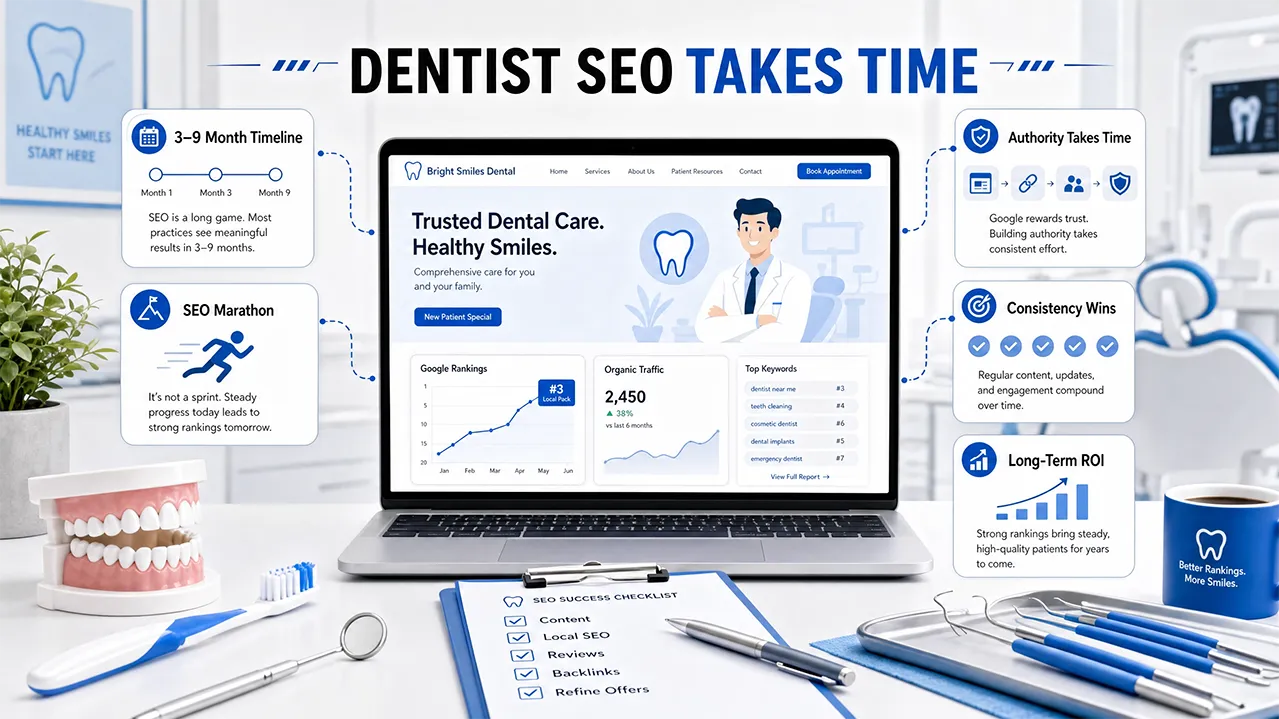
The most striking downside of SEO is that it simply takes time. It’s not unusual for a company to spend 3-9 months working on their SEO strategy before they start to notice serious results. For newer companies or clinics which have changed their domain name, this could take even longer as authority takes time to earn.
The solution to this problem is consistency. SEO is a marathon rather than a sprint, and the best results come from slowly building authority and other signals over time. You have to constantly refine your offerings, aiming to build prominence.
Despite the time and effort SEO takes to show solid results, it still generally offers the best value marketing tool for most companies.
Conclusion: Why Should Dentists Focus on Local SEO?
As a dentist, your patients are looking to make contact with you through search engines, AI recommendations and find your office via Maps. While it might be nice to appear in searches on the other side of the country, they’re unlikely to book an appointment.
Focusing on local SEO efforts means that when that tooth cracks, filling falls out, or it’s just time for a yearly check-up, it’s your office that they’ll find first. Put simply, when people have a problem, they turn to search engines and AIs for solutions; ranking well means you can offer it to them.
For dentists that specalize in less urgent procedures, local SEO should still be their main focus. While the urgency might not be there, supplying your patients with a detailed blog explaining their options might be the deciding factor that pushes them to get the work done.
