

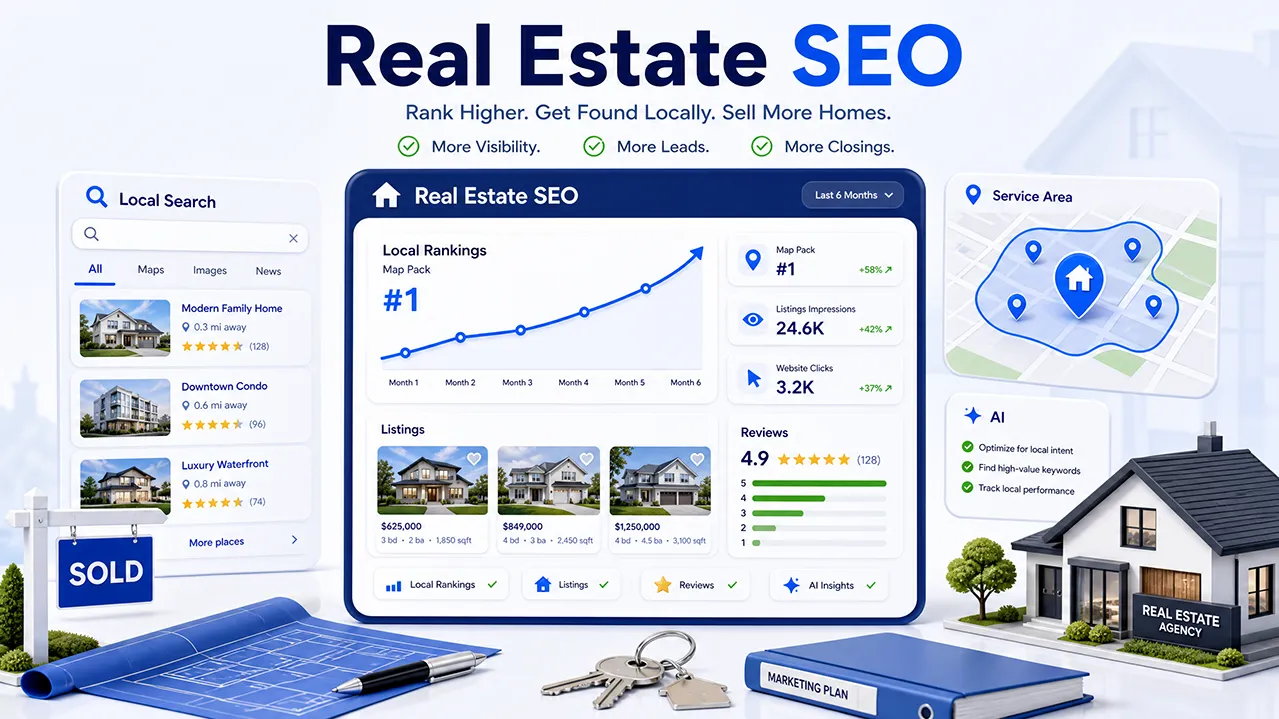
Real Estate SEO is slightly different from other forms of search engine optimization. While you want to appear well in searches from anywhere, your main focus should be hyper-local, zooming in on zip codes, neighbourhoods, and, in some circumstances, even streets.
This focus on local rankings means that when people search for, say, “3 bed house Edinburgh”, your listings or site is what they find first. While people might not have a clear picture of the housing market in a given area, they generally know where and what they’re looking for, so targeting these searches is where the conversions come from.
While property listing sites such as Zilow or Purple Bricks are major sources of traffic for estate agents, around 53% of all web traffic comes directly from search engines, and 97% of this goes to results on the first page. Put simply, how you tackle SEO as a realtor matters.
Planning Your Real Estate Business’s SEO Strategy
In the early days of the internet, SEO mostly consisted of shoving a relevant keyword into the text of a page as often as you could possibly manage. Today, things are considerably more complex and nuanced.
Search engines and AIs use a system that we call EEAT (expertise, experience, authority, and trustworthiness) to grade all the content they offer up in their results. All your content will be graded through this system to ensure that it’s both a good match for the searcher’s intent and high-quality information.
As real estate is probably the single largest investment most people will ever make, the criteria that Google applies to content around buying and selling property are even stricter than for most businesses. This is called Your Money or Your Life, and it aims to protect its users from falling prey to poor information on important financial and medical issues.
Types of Local Search
Local SEO can be split neatly into 3 main categories:
- Local Search- this is probably the most important area for real estate businesses and concerns how you appear in normal search results.
- AI recommendations and Mentions- Around 25% of all searches now have an AI summary attached, and 60% of people say they get all the information they need from these. The rise of people turning to chatbots like ChatGPT is also a consideration.
- Maps Searches- Maps are a useful tool for boosting your other SEO efforts and can help direct people to make contact with your agency.
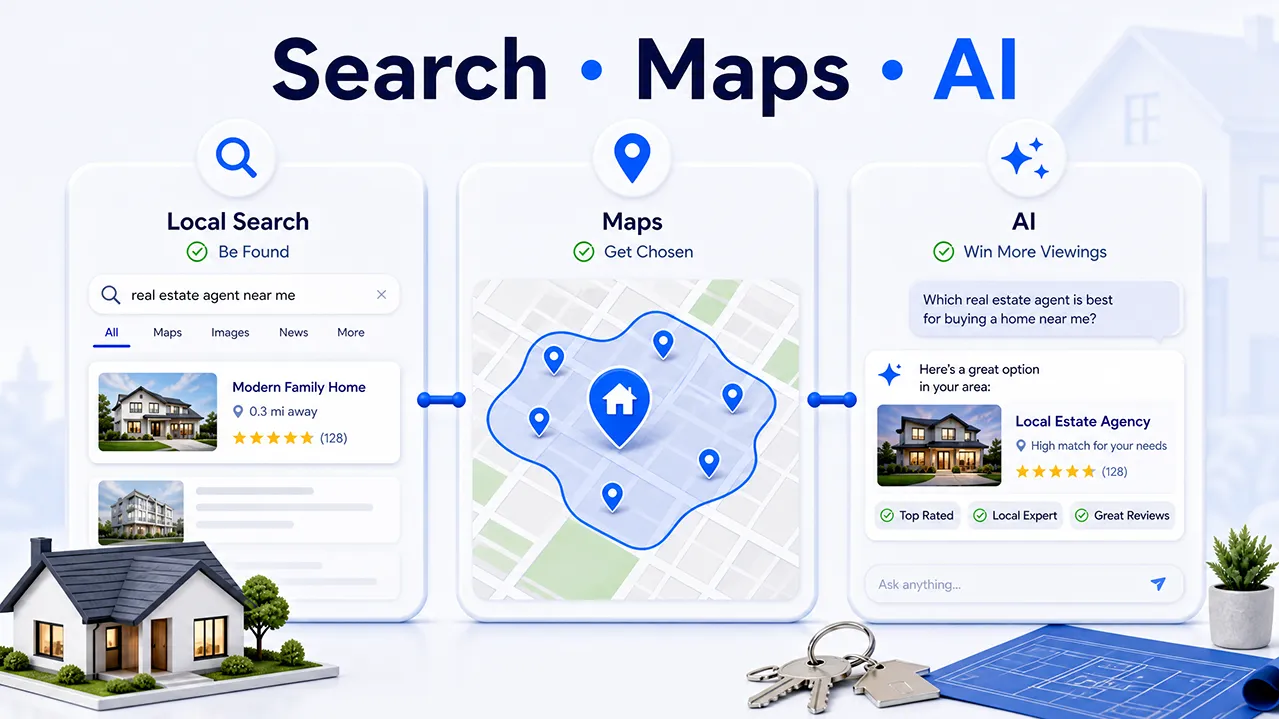
While ranking well in local search through carefully crafting your landing pages, listings, and blogs, there’s a lot of overlap between these areas. Each needs its own twist to make the most out of it, so your SEO strategy needs to have elements to deal with the needs of each.
Google Business Profile For Real Estate
Google Business Profile is a free tool that gives businesses access to Google Maps and lots of other useful features. It’s very easy to set up and can play a disproportionate role in all kinds of modern local SEO plans.
While Maps searches might be slightly limited in their usefulness for most real estate agents (though don’t discount them entirely- the top 3 results, or Map Pack, get around 93% more contacts than positions 4-10), Google Business Profile can do a lot for your business.
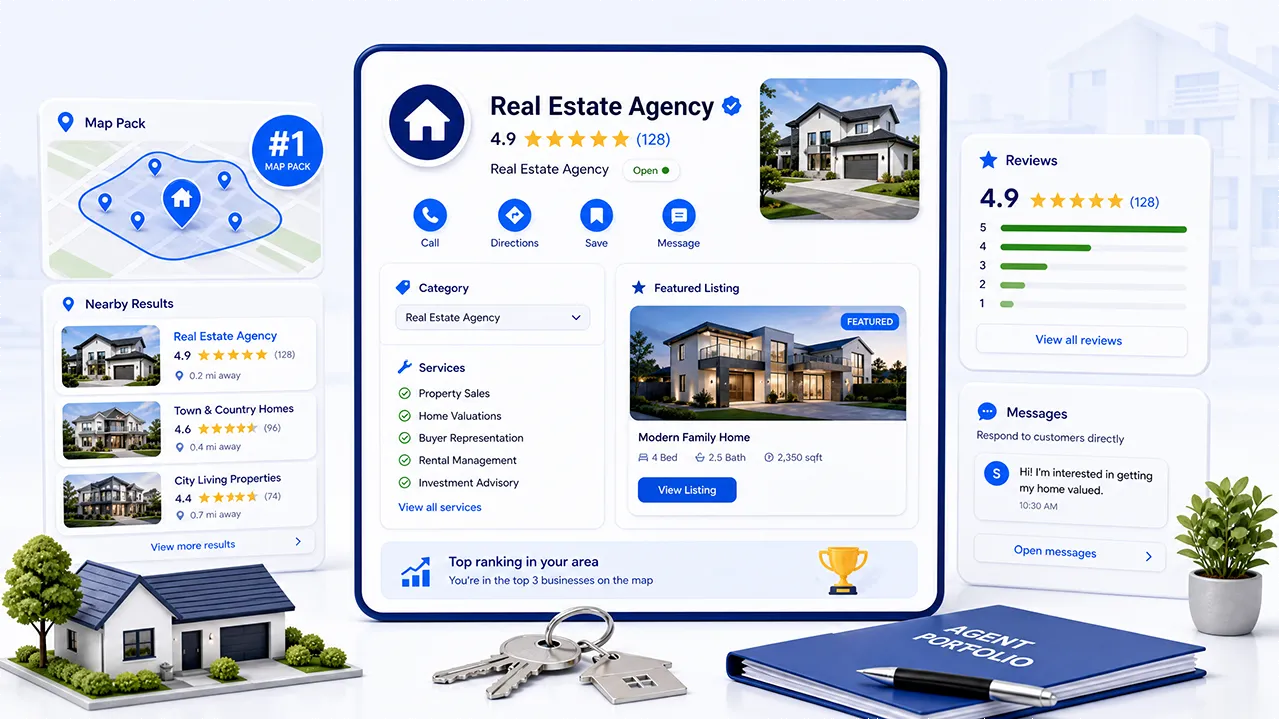
Your Google Business Profile gives you access to:
- Controlling how your business appears in local and Maps searches
- Interacting with your customers via reviews
- Highlighting certain listings
- Promoting your services
- Encouraging direct messages
Getting your profile up and running takes a few minutes- simply claim your account and verify (by phone, email, or post) that you are the owner, and it will start appearing in searches. Optimizing it to get the most out of it as possible will take a little more effort.
How Google Business Profile Ranks Your Business
The first thing to understand about Google Business Profile is that there is no single top spot. Instead, Google uses 3 major criteria to decide which order to show results in any given search:
- Proximity: how close the business is to the searcher when they made the query
- Relevance: how closely the content of the profile matches the search intent that Google thinks the searcher had.
- Prominence: how popular your business is with similar searchers.
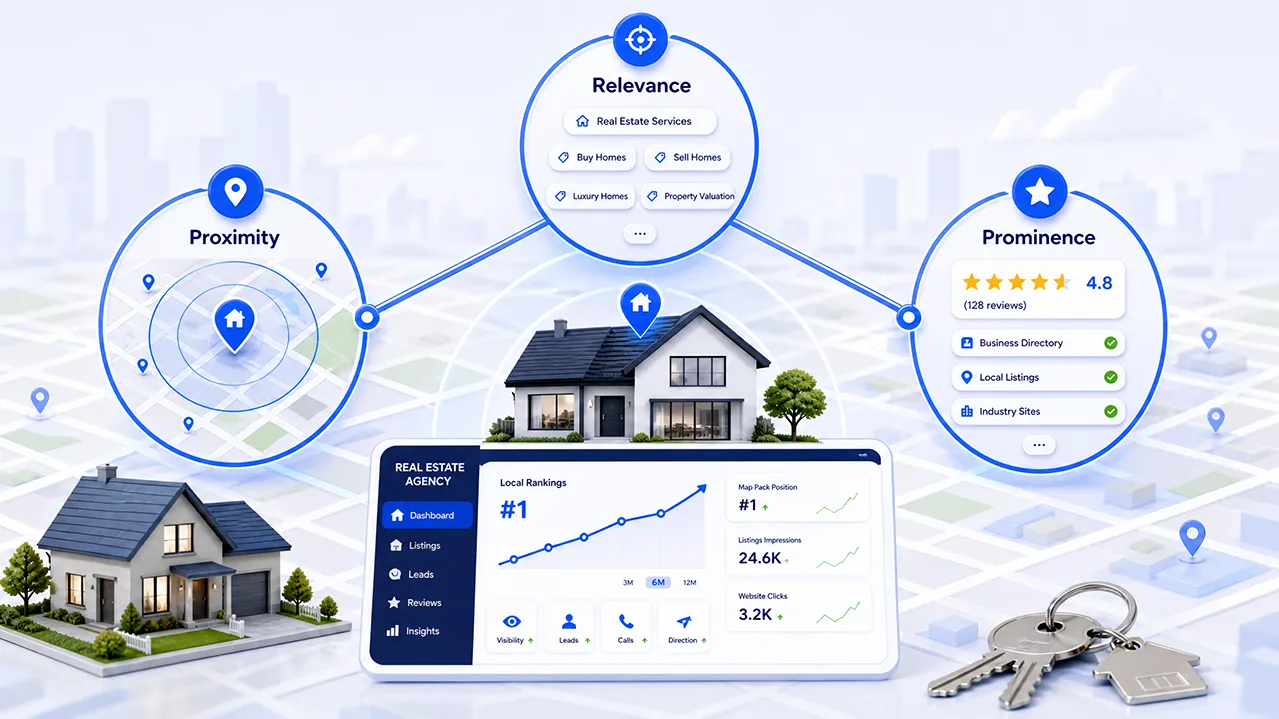
We’ve got a good level of control over how relevant we can make our profiles for a given search, but we’re limited to influencing the other results.
Relevance
Relevance is the factor that we have the most direct control over when it comes to getting the most out of our GBPs. This is what Google uses to decide how good a match your business is for what their users are really searching for. It’s based on the content of your profile, including business description and reviews.
The first step towards leveraging relevance is to ensure that your main category aligns with your business. In real estate, we’ve got 3 primary categories: Real Estate Agency (for brokers, agencies, and larger teams), Estate Agent (for solo agents), and Commercial Estate Agents (for commercial agencies).
Once the primary category has been chosen, you can select up to 9 secondary categories. These give you a chance to be a little more detailed, branching off into things like consulting, property management, or developer services.
After setting your categories, you can use the services list to offer even more granular details. This might include things like first-time buyer assistance, property valuations, or any other service that your customers are likely to be searching for.
Finally, write your business description. This is the ideal place to insert keywords that match the search terms your potential customers are using. You don’t have to match them exactly, and having a variety of ways to describe your services will bring better results than a simple list. That being said, avoid the temptation to put in too many- overoptimized profiles often trigger penalties.
Reviews
Reviews allow potential customers to get a sense of a business before they reach out and make contact, so it goes without saying that they’re worth their weight in gold. 96% of search engine users make use of Google Reviews, and they’re a fantastic way to build trust.
These are often the first point of contact that a customer will have with a business. Replying to them (even the bad ones) in a polite, friendly, and professional manner can go a long way. Google prioritizes active profiles, too, and this is a good way to demonstrate that your account hasn’t been abandoned.
Beyond their effects on the people who read them, reviews also send powerful signals of relevance and prominence to Google and the AIs who factor your GBP into their results, so encouraging them is important.
In terms of relevance, reviews are often keyword-rich. If someone has used your services to secure their first apartment (or anything else), ask them to leave you a review and talk about the experience. Don’t be afraid to get specific, as these reviews will help with your relevance score.
Reviews impact prominence, too. A steady stream of positive reviews (of 4 stars or more) will signal that you are a respectable, reliable, and established business and, therefore, a good result to offer searchers.
Proximity
Proximity is the factor that we have the least direct power over- we simply can’t control where someone happens to be sitting when they search for “5 bed, 3 bath townhouse Alberta”. That is not to say that we can’t do anything to influence which searches we appear in.
When setting up your profile, set a service area. This can be as wide or tight as you like (within a roughly 2-hour dive radius of your office). You can set up to 20 of them from a single GBP, which can be very useful if your agency specializes in certain neighbourhoods across a geographic region.
When people search within these areas (or name them in their query), your profile will be included in the search results.
Prominence
Prominence is a rough estimate of how popular your business is within your local area. The main factors in this metric are your reviews (the more positive ones the better), how long your profile has been active, and how your business appears elsewhere online.
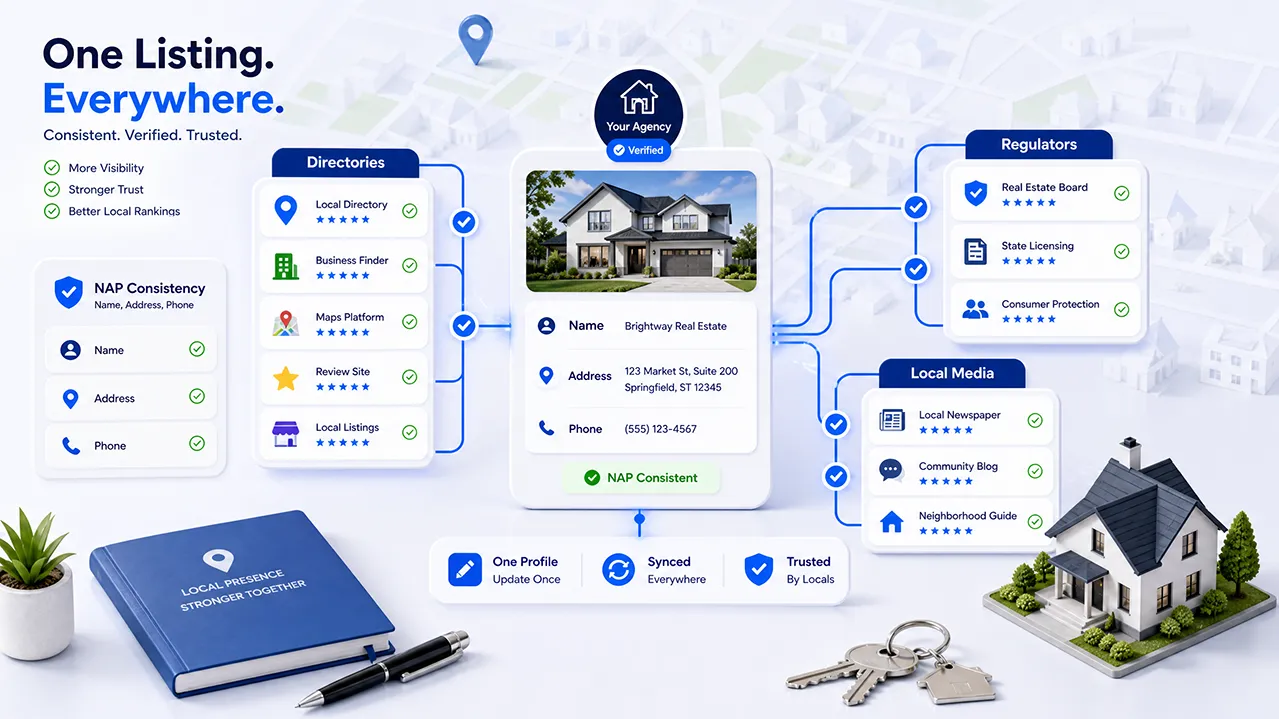
We have the most control over how our business appears elsewhere online here. Ensure that you’re listed in all the relevant places- listings sites, local directories, and regulatory bodies. It’s vitally important that your name, address, and phone number (NAP) and all your other contact details are identical across any listing to avoid confusing the AIs, search engines, or, more importantly, people trying to get in touch.
As real estate comes under the umbrella of Your Money or Your Life, the quality of these listings is important, with regulators and industry bodies being the main thing to focus on, closely followed by local listings.
Real Estate Local SEO
Probably the single most useful area that you can focus on when marketing your agency is how you appear in traditional local searches. These are the “warehouse for sale, Ontario”, or “4 bed, 2 Bath Aberdeen”, or even “sell my home, Dunblane” searches that your clients are asking Google, Bing, or their search engine of choice. Much of this work will also hugely increase your chances of being mentioned by AIs and appearing in search summaries.
As real estate is a huge investment, the search engines want to be sure that your content is reliable and your business is reputable. This places even stricter criteria on your content when it comes to giving it the best chance of ranking.
While this may seem like a lot of work, when you consider the sheer volume of traffic that a well-executed SEO strategy can bring in, it’s well worth it. With around 73% of all clicks going to the top 3 results, ranking can make all the difference.
How Do Search Engines and AI Rank Content?
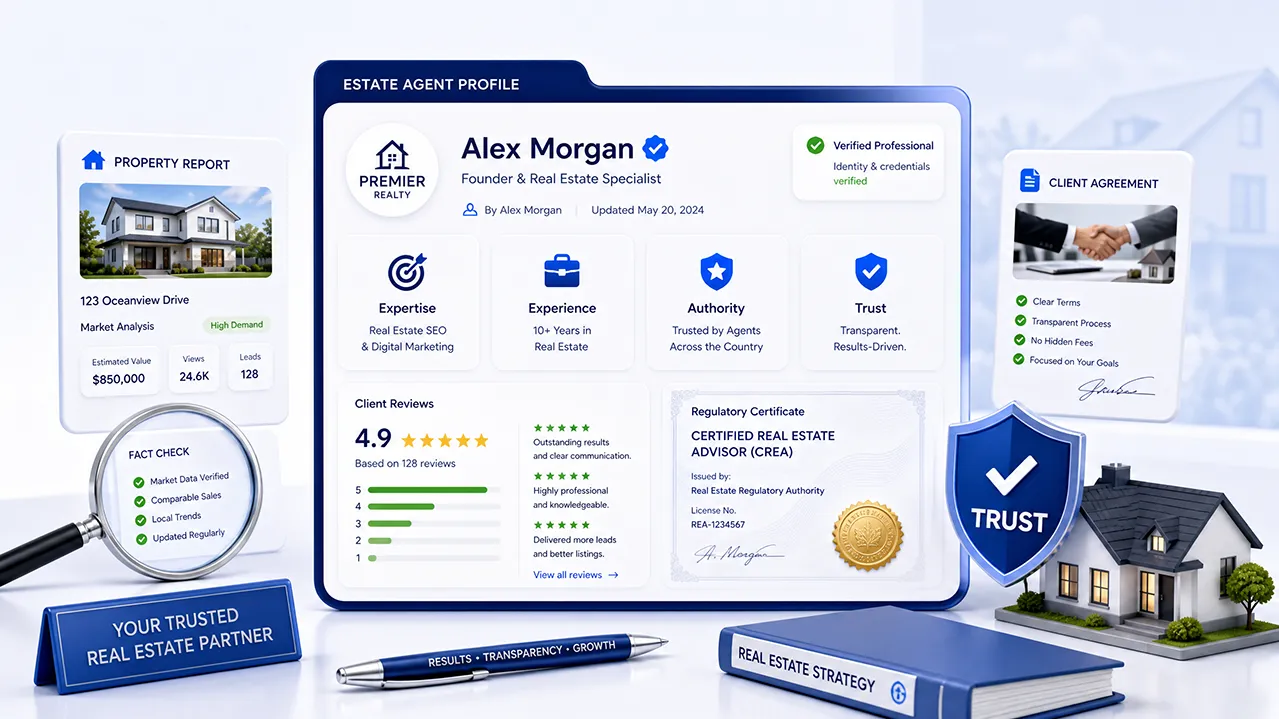
Search engines and AIs send out bots known as crawlers to trawl and map the internet. These bots grade everything they find through a set of metrics we call Expertise, Experience, Authority, and Trustworthiness (EEAT). These are used to determine how well a page meets a user's search intent and how reliable the information appears to be.
Every single piece of content online is graded through this system, and the general rule is that the closer it matches a search intent and the more human-centric it is (backed up by verified facts), the better it will rank.
Topical Authority
As real estate is contained within the Your Money or Your Life guidelines, topical authority has to play a larger role in your SEO efforts than it might for a random blog or e-shop. We’ve briefly covered how EEAT applies to your individual pages; it also applies to your site as a whole.
This means that all of your content factors into how your pages rank, and where and how you’re mentioned also matters.
You have control over your own content (and at least some of your backlinks), so it’s important to focus on ensuring that this all showcases your expertise, authority, and trustworthiness and is accurate, deep, and transparently written. The aim should be to avoid any chances of miscommunication or misleading people who might rely on you for the largest investment of their lives.
One simple way to spread your authority between pages is simply linking between them. Your blogs can lend authority to your landing pages as well as offer your clients deeper information. This is great for your topical authority, and it also helps those salesy landing pages to rank, too.
Page Authority
Search engines use various things to decide how authoritative your content is, but the primary mechanics are all related to how you link to other sites to back up your points and how other sites link to yours.
Backlinks- the links from other sites that point towards yours- are seen by AIs and search engines as evidence that your content is good, correct, and worth sharing. Outgoing links are seen as evidence that you have done your research and your interpretations are valid.
As real estate is covered by Google’s Your Money or Your Life criteria, the quality of these links matters a lot more than it would in, say, software engineering or another business. In fact, the quality and how closely the content mirrors the content of the link matter far more than the quantity.
Your authority-building efforts should be laser-focused on your blogs, landing pages, and category pages, avoiding your individual listings as much as possible. We don’t want to compete with ourselves, so investing time into authority-building on a fundamentally transitory page is a waste of time and is generally counterproductive.
Out-Going Links
Outgoing links should be scattered around all of your content, offering readers more information and demonstrating that your points are well-researched. They’re free, and you could link to any other site that you choose, though some will be more effective than others.
Good sources of outgoing links for anyone in real estate will include things like:
- Partner websites- developers, local authorities, mortgage advisors, and other groups you regularly work alongside.
- Regulatory Bodies- any licensing boards you’re certified by
- Local businesses- placing your business (and listings) in a local area will help with local SEO.
Backlinks
Backlinks are the links hosted on other sites that point towards your content, serving as a sort of citation that your writing is worth sharing and your points are right. Some will be earned naturally over time as people find your content and want to share it, and others can be arranged either through listings or by content marketing.
While there are no bad links, as a business under the auspices of Your Money or Your Life, some links are far more valuable than others. These should be high-authority, topically relevant pages like:
- Regulatory Bodies
- Local media and established blogs
- Industry Blogs
- Local Directories
Reach out and offer to write a blog about your local beat or the housing market and link back to the relevant content on your site. This will help you to build authority and spread it around to the content that you want to rank.
Expertise, Experience, and Trust
The other metrics that Google, other search engines, and the AIs all take into account are about the nature of your content. Everything you write should take them into account and present them in an easily verifiable way.
In effect, this means that every piece of content should be co-authored by a qualified, experienced agent. Work closely with a copywriter to meet these criteria and ensure that your content is written in a human-centric way- your first audience is always real people, and luckily, what they want to see is also what AIs and search engines like too.
The best way to demonstrate that your content is written by someone who knows what they’re talking about is simply to use the byline to link to a profile page where their qualifications and experience are laid out. This is great for building trust with AIs, search engines, and potential customers alike.
Content Types
There are four really relevant types of content that every real estate site should have:
- Listings- the actual properties that you’re marketing
- Category Pages- groups of listings, generally by property type or location
- Blogs- in-depth articles explaining a topic in detail
- Landing Pages- Sales-focused pages that encourage people to make contact.
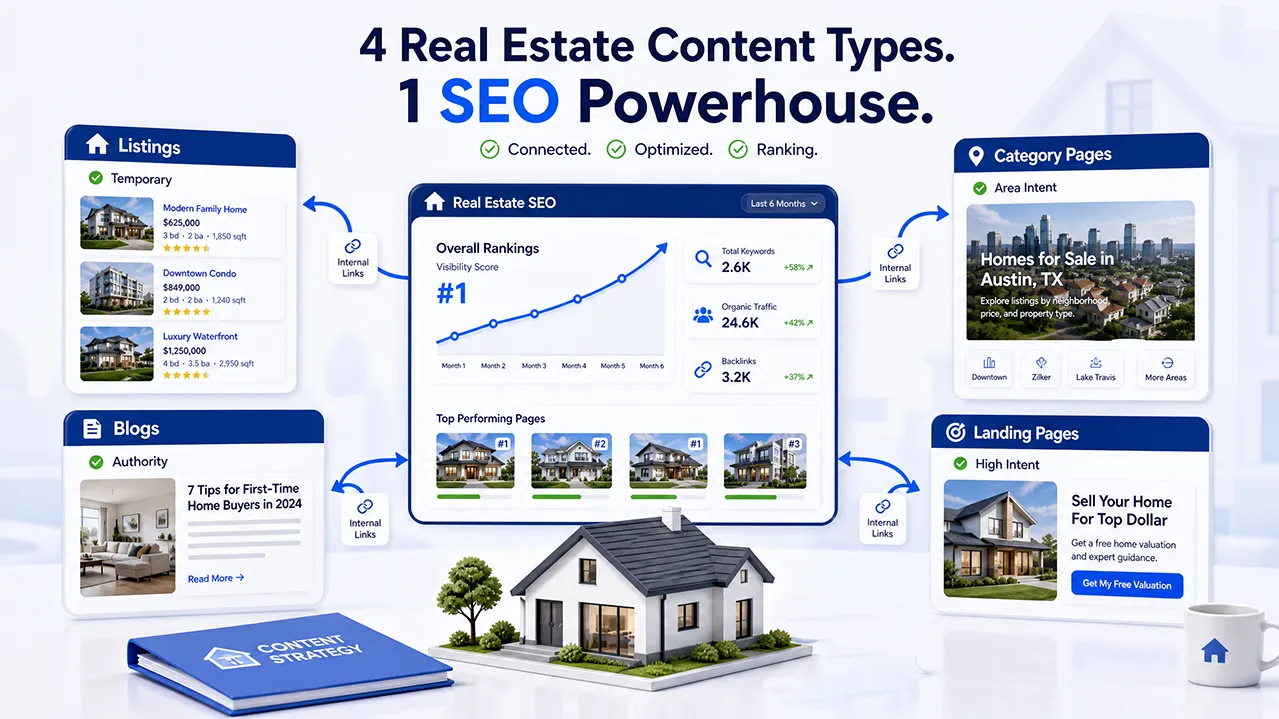
Each type of page should be written to meet the EEAT criteria, reading well and being transparently authored.
Blogs
Blogs are the best way to go about building up topical authority and spreading it around your site. They give you a neat and easy way to really explore a topic in-depth, building trust with potential clients, too.
In the case of real estate companies, they have to be really quite specialized, so it’s worth thinking about what topics are most relevant. The following topics are worth exploring:
- Buyers’ Guides- what to look for in a new property
- Area Guides- what’s it really like to live somewhere?
- Sellers' Guides- what actions do you need to take to get the best price?
- Market analysis- how is the local market developing?
These all target general informational searches rather than people who are looking to buy, rent, or sell a property immediately, but that doesn’t make them less valuable. They aim to provide a lot of information and build authority, which can then be spread around your other pages.
Landing Pages
Where blogs target general information searches, landing pages are aimed squarely at those looking to act now. They’re shorter, punchier, and sales-focused. Each service that you offer should have its own dedicated page, laying out the problems you can solve and why you’re best positioned to solve them.
With each service having its own dedicated page, it’s much easier to target the high-intent searches that people might be doing. Keep your keywords (more on these further down) targeted and use your blogs to add more authority.
Listings
These are the properties that you’re marketing. As a rule, we don’t want these to be listed directly in SERPs, as with any luck, they’ll be sold or let before the crawlers can evaluate them. The aim here should be to have such a low authority score that they don’t compete with the rest of your content at all.
It might be worth including a NoIndex tag in the HTML header of your listings pages to tell the search engine and AI crawlers that this content is not for them. It’s never worth cultivating backlinks that point towards an individual listing for this reason.
Categories Pages
While individual listings are temporary and should be removed when properties sell, the broader categories that they fit into can be a really useful place to direct searchers. People will generally have a pretty good idea of what they’re looking for in a home or business location, and this means we can target their search intent closely.
Group your listings into broader categories, such as location. You can then build an introduction around that category and build a little authority, which can be further enhanced through internal links or even pointing backlinks towards it.
Localizing Your Content
As we’re focused on hyper-local SEO, ensuring that all your content places you firmly within certain geographical boundaries is important. This is mostly done through simply naming your target location relatively often (without becoming too “spammy”) within your content. Something like “Downtown LA’s Letting Specialists” does the job nicely.
Your localization efforts must be a natural part of your writing and avoid seeming like they’ve been shoehorned in for the sake of SEO. There are a few reasons behind this:
- It reads unnaturally- your writing should be natural and conversational. People will notice if the same phrase is used over and over, destroying trust.
- AIs and Search Engines will penalize overoptimization- content that is purely for SEO purposes and contains little or no real value for the reader isn’t what Google or ChatGPT wants to offer. This is especially true for major investments like real estate.
Technical SEO
Not all your SEO efforts should be focused entirely on your content- there are a couple of important (and often neglected) elements that can make a difference to how many people choose to click your link and how much information search engines and AIs can glean from your pages.
Designing Your Site
The way you design your site can have a surprisingly large impact on how well your SEO efforts work out. Thanks to a metric called bounce rate, which aims to measure engagement with your content, how user-friendly and easy to navigate your site is can make a huge difference.
With over 60% of local searches happening on mobiles, designing your site for these users makes the most sense. This means limiting images to only the most useful, using single-column layouts, and keeping your navigation simple. Quality of life improvements, like a “call now” button, can also help boost the impact.
Perhaps the most important factor to consider when designing your site is how quickly it loads. 38% of visitors will navigate away if they have to wait between 7 and 10 seconds, and 25% won’t even wait for 3 seconds to pass. This means keeping unnecessary images to a minimum and avoiding over-complicated plugins.
Which Images and Videos are Worth Using?
Working in real estate, you’ll already have a good idea of which photos, videos, and other visual media will have the most impact, so there are no real “hard-and-fast” rules around what you should or shouldn’t include in a given piece of content.
That being said, ensure that every photo you do include serves a purpose. Each one could add anywhere up to several seconds to your page’s loading time (depending on the connection), so they really have to pull their weight to counterbalance user impatience.
It’s also worth spending time optimizing each image to reduce its file size and loading time. There are plenty of free tools that should allow you to do this fairly easily.
To improve site loading times, it’s generally best to host your videos on something like YouTube or Vimeo or make use of Content Delivery Networks (CDNs), so that they can load more quickly. It’s also a good idea to ensure that autoplay is turned off, meaning that the video isn’t competing for bandwidth with the rest of your page, and people can watch it if they choose.
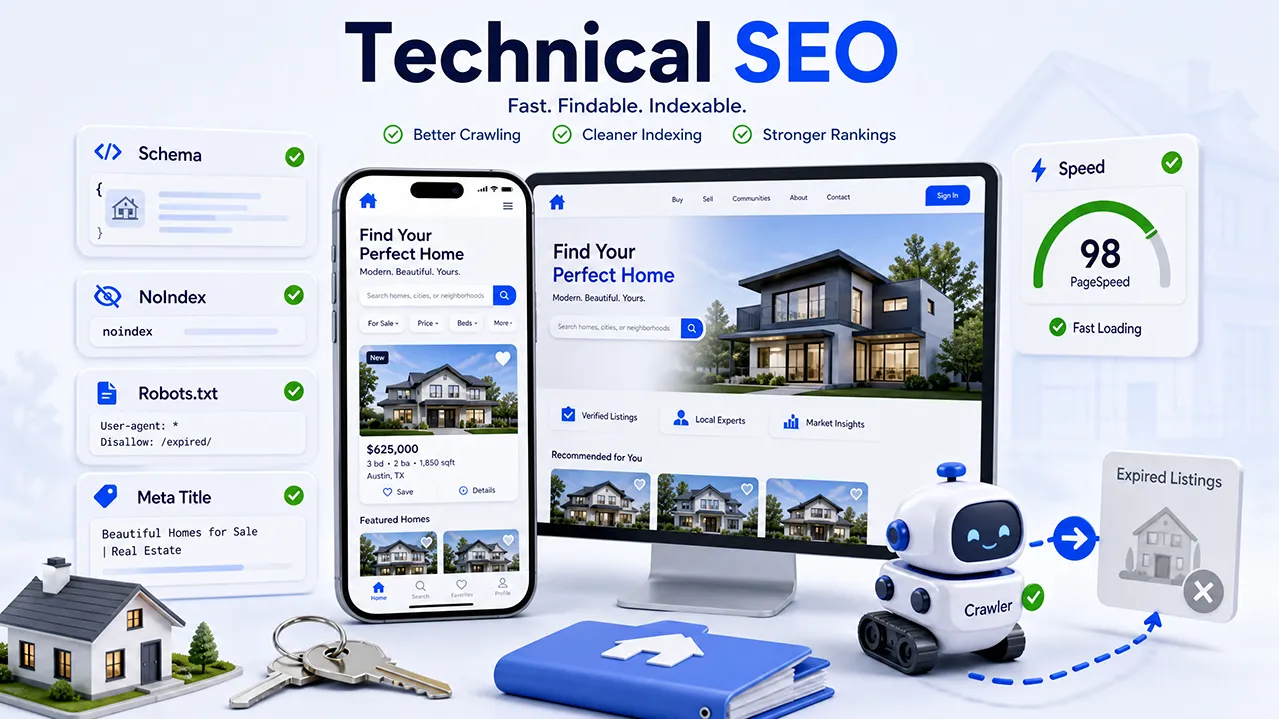
Robot.txt and NoIndex
In the case of most real estate sites, the single largest section of your content will be made up of individual listings. These are, by nature, short-lived pages- once the property is bought or rented, they should be taken down and replaced with the next one. This presents a problem for SEO, as we don’t want people being directed to dead pages and damaging their trust or our bounce rate.
Robot.txt is a small text document that sits alongside your index and content in your hosting folder. Its primary purpose is to send instructions to web crawlers from search engines and AIs and tell them what is and isn’t worth them listing. While respectable crawlers like Google or ChatGPT will generally honor these commands, they’re mostly about directing them towards more important parts of your site.
While Robot.txt can send instructions and help avoid bots from overwhelming your servers, to avoid a page appearing on Google at all, we’ll need to set up a NoIndex tag. These form part of the header page of your HTML and act as a hard block on listing, even if your content is linked to elsewhere.
Structured Data
Structured data types, like Schema Markup, are simple bits of code that sit alongside your page’s HTML and offer information to search engines and AIs. They also allow your listings to have “rich snippets” containing information around prices, opening times, and features like “call now” buttons or FAQs right on the SERP.
There are various schemas that might be useful for a real estate agent, the most obvious being RealEstateAgent. For listings, RealEstateListing should be the go-to option.
Include as much information as possible when deploying these markups, as they’re a great way of establishing expertise. Include any qualifications, as these make it easy for Google or ChatGPT to feel confident in recommending your services.
Local Listings
The content on your own site isn’t the only concern when thinking about your local SEO. How you appear on other relevant sites also has an impact. Local directories are a sort of digital phonebook, and they serve three main purposes:
- Local placement: Being listed on a city or state directory places you firmly in that location.
- NAP reinforcement: Putting your name, address, and contact details out there on many sites in exactly the same way reinforces how well established you are.
- A high-quality, locally relevant backlink: Reinforce your local credentials and topical authority by listing in the relevant places.
List yourself wherever you think might be useful, including local regulators, industry bodies, and local business directories. Each one will further reinforce your locality and help you rank for those all-important geo-tagged searches.
Contact Details
The whole point of digital marketing is to encourage people to call, email, or book an appointment, and the only way they can do that is if your contact details are easily accessible. That means listing them in as many places as possible.
It’s vitally important that you ensure that your Name, Address, Phone Number (NAP- really all your contact details) are exactly the same wherever they happen to be listed. This avoids the risk of confusing search engines and AIs, or worse, real people seeking to get in touch and use your services.
What are Good Sources of Real Estate Backlinks?
Backlinks, as we’ve already mentioned, are the primary signals of authority that search engines and AIs take into account, and they can drive more traffic to your site directly than you might think.
These basically send the signal that the content you’re offering is good enough that other people want to highlight it. For anyone covered by Your Money or Your Life, the quality is far more important than the raw number of links pointing at your site.
These incoming links should be targeted towards your blogs and landing pages, and category pages (whichever is most appropriate for the context and whichever you’re actively trying to rank for). They generally aren’t worth pointing to your landing pages, as we don’t want these to generate much authority themselves.
There are two types of backlinks that are worth trying to develop: topical and local.
Local Backlinks
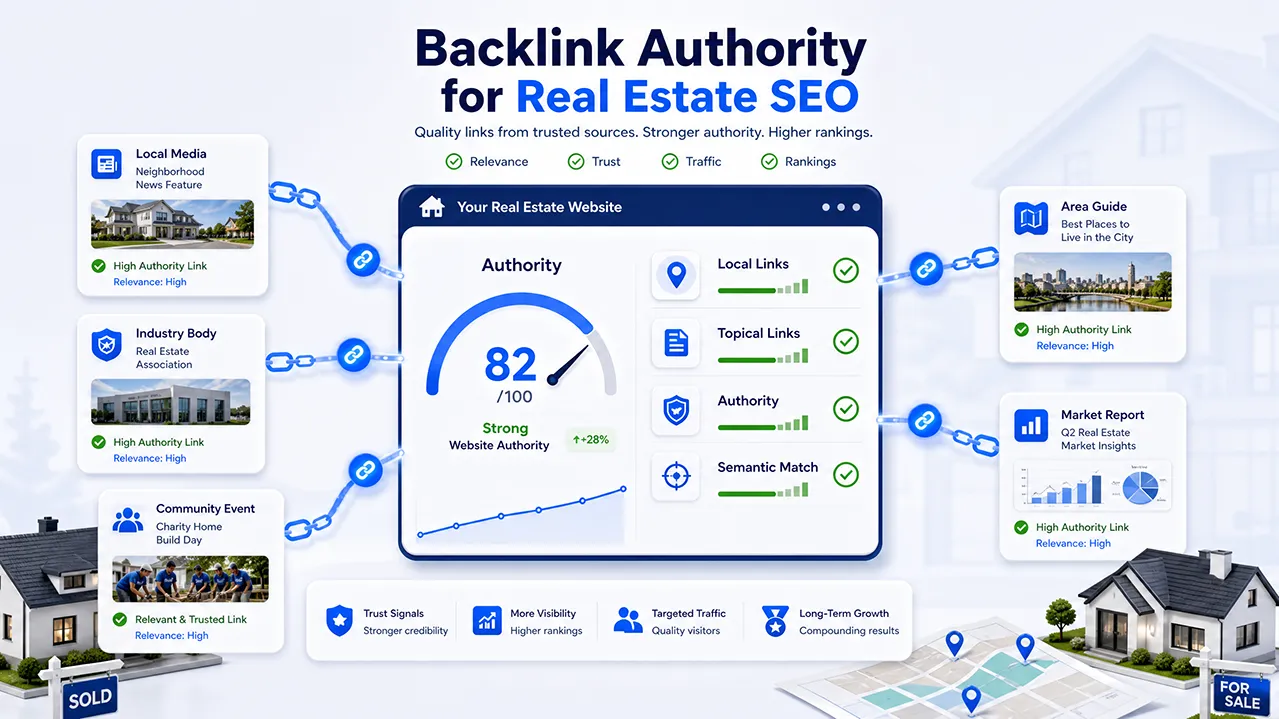
Local backlinks, as we’ve already covered, send strong signals that your business is respected and prominent in your local area. These are the listings on local directories, mentions on local blogs and new sites, and any other page that places you in a certain location in the eyes of Google or Claude.
We’ve already covered local listings, but other important sources might be things like local newspapers, TV and Radio stations, charities, and community event pages. Reach out and offer quotes, sponsorships, and generally build links within your local community, and you’ll quickly earn high-quality backlinks into the bargain.
Topical Backlinks
Topical backlinks are harder to come by, but they’re worth their weight in gold when it comes to building authority, especially when it comes to meeting the stringent rules around Your Money or
Your Life topics and earning AI mentions.
The best sources of these will come from reaching out to industry bodies, local press, and other relevant sites and offering to write some content for them. An overview of a new development or changes in the market over the last year could form a good excuse to link back to your own page.
How AI Treats Backlinks
Both search engines and AI place a lot of importance on how your site is linked to around the internet, but AI treats them a little differently. All the guidelines we’ve already covered still apply, but when it comes to earning an AI mention, the context of the link matters a lot more.
This contextual link is known as “semantic linking”, and it relies on ensuring that the content of your page and the content around the embedded link are a close match in meaning. For example, if you’re writing a guest post about changes in the law around rental properties, linking to your rental agent landing page will be far more useful than your homepage.
It’s worth checking which sites your target AI already mentions in its responses, as these will have already been crawled and judged to have earned a good topical authority score. Reach out to these sites and offer them some content, and your chances of being mentioned will increase.
Picking Keywords for Real Estate Content
Keywords are the most basic element of any SEO strategy, forming the basis of all our efforts. These are the words and phrases that users enter into the search bar, and AIs and search engines use to determine what exactly they’re looking for.
They send signals that tell search engines and AIs what your content is about and which search intents (transactional or informational) it best matches.
In the old days, using keywords generally meant simply mentioning your target search phrase more often than your competitors. That is no longer the case, and things are significantly more nuanced than they once were. In fact, overstuffing keywords is now likely to see your pages demoted rather than rising up the rankings.
Today, natural usage of keywords or a close semantic match is far more important in determining rankings than simply repeating them over and over again.
Choosing Keywords
Choosing the right keywords to focus on is the first step towards building your content and basically means deciding which search terms and AI queries you’re placing the most value on. While you could do this manually by conducting dozens of searches and AI interactions yourself, there are simple tools that can make life much easier.
These tools will present all kinds of relevant data around how your competitors are using keywords and how much work it will take to outrank them. Simply think of your target phrases and enter them into the tool, and then use the information to judge what is and is not worth competing for.
Finding Balance
Keyword research tools generally give you three main metrics to evaluate a keyword by:
- Volume: the number of searches involving that keyword each month
- Competition: the number of pages targeting it
- Difficulty: an estimate of the average domain authority of the competing sites
While the general aim of SEO is to rank at the top of the SERPs for the most searches possible, there’s a little nuance to consider here. While ranking number 1 for the most common search terms is great, it’s not always possible, as everyone else is jostling for that spot too.
Instead, it can often be wiser to find a compromise between these three metrics. Rather than focusing on a hugely popular search term, find a slightly lower volume equivalent that is easier to rank for.
With nearly 40% of all clicks going to the first result alone, aiming for a bigger slice of a smaller pie can often yield the best results. You might appear in fewer searches, but you’ll probably still net more clicks, and clicks are what drive conversions rather than impressions.
That being said, some of the highest competition keywords are all but unavoidable. Developers will have to mention development relatively often in their content, and rental agencies will, likewise, need to mention that they’re a rental agency fairly often.
You can somewhat limit the competition by including a local marker with these keywords, such as “housebuilders in Wales” or “Detroit’s Renovations Specialists”.
Deploying Keywords In Your Content
Once you’ve identified your target keywords, you should start writing your content. Scatter them (and closely related terms) through your landing pages, blogs, and listings, but avoid the temptation to veer into repetitiveness. Content must always read naturally, to appeal to human readers and bots alike- it’s a balancing act between including them enough times to compete and being accused of “overoptimization”.
Think of your content like having a conversation with someone about the subject. You wouldn’t simply keep saying the same phrases over and over again- that would be weird and stilted. Instead, you’d find other ways to make your point. SEO content should follow the same pattern.
Which keywords make most sense for a given bit of content will vary, depending on the search intention you’re targeting. There are two different search intents that are worth targeting: informational and transactional. Generally, the “hard sell” comes from landing pages, and the information comes from blogs.
- For your landing pages, which target immediate contacts, you might want to aim for something like “sell your home”.
- For blogs, which are aiming at more general informational searches, something like “tips for selling your home” might make more sense.
- Category pages should target the area and property type. Think “houses in Falkirk” or “industrial workshops in Birmingham”.
Semantic Linking
As we mentioned in the last section, simply stuffing the same keyword in again and again is not a useful strategy. Luckily, thanks to the process of latent semantic indexing, we have options that allow us to get a little creative.
Once upon a time, search engines simply took the raw number of times a certain keyword was mentioned in a text and presented their results in descending order. Today, they’re far more sophisticated. Both AIs and search engines group keywords into broader topics of related terms.
This means that they can gain a better understanding of naturally written content and be more confident about offering it up in the SERPs. If a blog contains phrases like “features buyers really want”, “dressing your home for market”, and “maximizing your return on your home”, it’s probably fair to say that it’s a blog about selling your house and a good result to offer when someone asks about the topic.
It also means that you can mix up your writing, rather than slavishly trying to squeeze a certain phrase in over and over. This means your work can be more engaging (which is great for your bounce rate).
While LSI is great for working with traditional searches, it’s absolutely vital for targeting AI mentions. Chatbots absolutely love to be able to lift full phrases from the content they reference, and including closely linked terms means they can be far more conversational in their responses.
Longtail Keywords
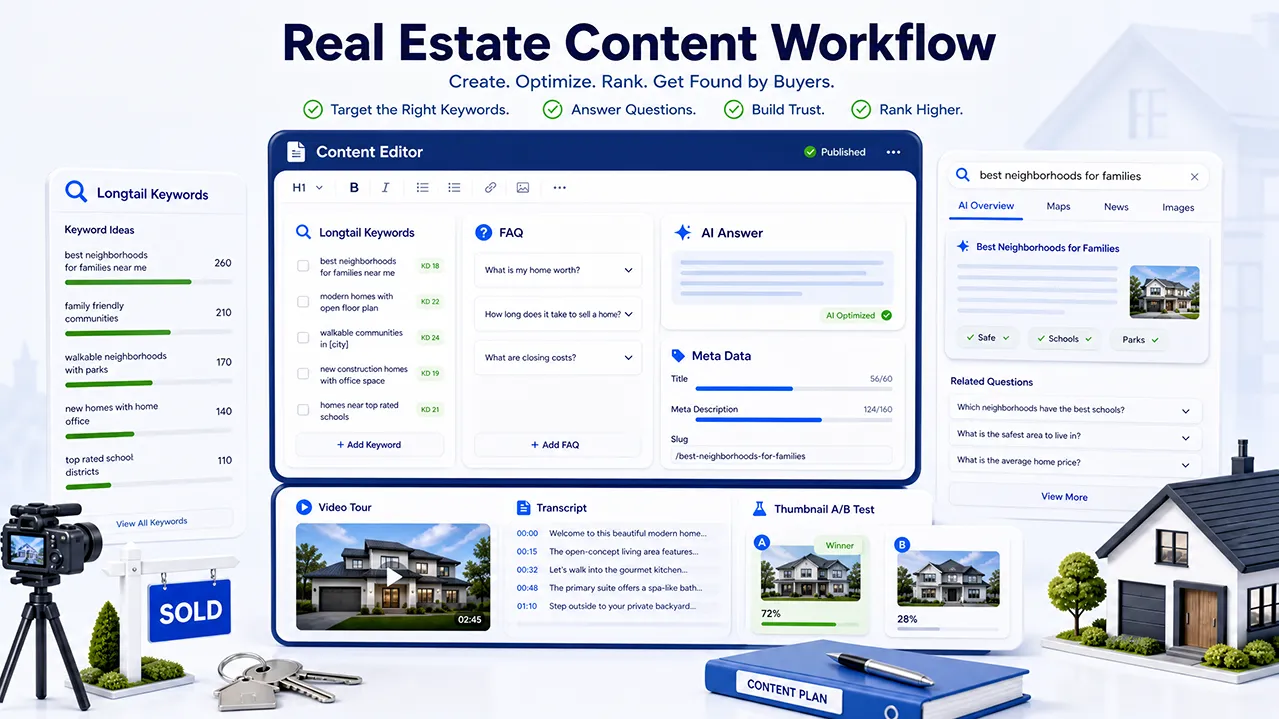
When people search for topics related to real estate, they’re unlikely to simply search for “houses” or “shops”. Instead, they’ll include more information in their search queries, such as “2 bed house to let, Kingston” or “business properties with parking”.
This means that we should be targeting these longer, more context-rich phrases in our content too. This is especially true if AI mentions are your main aim, as people tend to phrase their prompts in a far more conversational, context-laden manner.
Target Closely
While there’s always the temptation to create a single piece of content that simply targets literally everything, it’s generally a pretty terrible idea for a few reasons:
- Search engines and AIs like useful content. Overstuffing keywords signals that this is purely an SEO exercise, and it won’t rank. Useful content focuses on a certain topic and doesn’t really stray from it.
- People generally know what they’re looking for. Someone who is wondering what the process is for becoming a landlord doesn’t want to read about buying warehouses and vice versa. If they click your link and find the wrong thing, they’ll navigate away, damaging your bounce rate.
Keeping your keywords closely targeted means that when people search for help with a certain real estate problem, you’re there, waiting to offer a solution. While it might take more time to create content that aims at a wider variety of searches, the amount of traffic (and conversions) will always be better if you target carefully.
AI and Keywords
Content Writing For Real Estate Businesses
This means that you should spend more time on actually answering the questions you think people are likely to ask than carefully inserting stock keywords. It’s often worth using your headings to ask the question before answering it in the body, making life easy for the chatbots and allowing you to fit your keywords in naturally too.
AI still uses keywords to identify which pages are worth pulling information from, but it treats them a little differently. All the guidelines we’ve already covered are still important, but there’s a much heavier emphasis on semantic links and meaning rather than exactly matching a particular phrase.
Once you’ve worked out which keywords are worth targeting, you then have to set about writing the content that will contain them. There are four types of content that you’ll need for most real estate businesses: blogs, landing pages, categories, and listings.
While listings are fairly transitory- they hopefully won't be listed for long- blogs and landing pages can be long-term, evergreen content and therefore are worth investing a little extra effort into. These can bring in traffic for years to come if they’re crafted carefully.
As you’re covered by Your Money or Your Life rules, all your content is going to have to be absolutely top-notch in terms of your EEAT, so work closely with your copywriters to ensure everything is above board.
Writing Listings
As we’ve said, listings pages should, hopefully, not be live for too long- with the speed that most homes and business premises sell, they can often be offline before the search engines and AIs can properly crawl them.
When this happens, a dead link might appear in the search engine results, taking people to a blank or error page when they click on it. It goes without saying that this is not a great thing for people to find when searching for a home, and it can damage trust.
Rather than risk this happening, it’s a good idea to practice expired listing management and avoid indexing these (hopefully) transitory pages at all. These pages should generally have a NoIndex tag embedded in the header of your HTML to avoid them being listed and should be removed from the site relatively quickly.
This also means that your SEO efforts should really be focused on all the other content that you produce, like your blogs and landing pages. It’s not worth spending money or time buying backlinks for a page that will only be listed for a few weeks.
The aim should be to avoid building authority and competing with your own SEO focused pages, making them harder to rank. Avoid links on your listings beyond a “contact us to arrange a viewing” button.
One example where this might not be true would be short-term lets. These operate on a rolling basis, so it might actually be worth having them indexed and attracting traffic directly from search engines and AIs, as the listing can remain live, even when currently occupied.
Writing Category Pages
Grouping your listings together into broader categories, based on things like area, number of bedrooms, or some other filter, can make a lot of sense for three reasons.
Firstly, it makes navigating your site easier for your potential clients. If they search for something like “4 bed, detached house, Rubislaw”, then they’ll be served up all your offerings that match their needs.
Secondly, it allows us to build a little authority on the topic without wasting time building it on individual listings, which should only be live for a short while. While the non-listing content should be relatively short (a few paragraphs about the area), it’s a great place to link to your relevant blogs and landing pages.
Finally, having a page dedicated to listings in each area can capture a lot of high-intent searches. People generally know which areas of a city or state they’re interested in, and having a page dedicated to each means that they can see all the options in one neat package.
It’s also worth putting a more detailed filter option on these pages, allowing people to narrow down their search even more, as it will help with engagement metrics by making life as easy as possible for your visitors.
Writing Blogs
Blogs are how we target informational searches, and there’s no end of potential topics you could cover in real estate. They allow you to really explore a topic in a little depth, building both authority for search engines and AIs and showing off your knowledge to your readers. They’re absolutely fantastic for building trust, too, which is important for anyone who deals with major investments.
When it comes to SEO purposes, blogs have three roles. Firstly, they tempt in those general information searches, offering a proper exploration of the topic to human readers. Secondly, they build authority, which can be spread around your site via internal linking. Lastly, they stand out to AIs, allowing them to offer better quality answers to their users.
Each blog will be different, depending on your brand voice, the topic, and who you’re targeting, but there are some general rules that are worth keeping in mind:
- Present information in an inverted pyramid. This means offering a basic answer and then slowly building up detail and nuance as you go. This makes your content easy to read and understand for both humans and bots.
- Use links to back up your information. These act like citations in an essay and let you borrow a little authority from the target site, letting your readers learn more. Choose them carefully.
- Keep authorship transparent. It’s worth using bylines to link to a profile page of the agent who wrote it. If you’re working with a copywriter, make sure that they’ve got a decent level of experience in the area that can be proven.
While blogs are mostly meant to be informative, a call to action or a little soft selling isn’t a total deal breaker. Just ensure that the main thrust is always informing the reader about the issue at hand.
Writing Landing Pages
Landing pages target high-intent searches. These are your best tools for ranking in those searches that lead to phone calls, viewings, and people actually buying or selling their properties. They should be short, punchy, and aim to offer a direct solution to a particular problem.
Every service that you offer should have its own dedicated landing page, allowing you to closely target the most relevant searches. Include as many relevant details as you can, including things like your pricing structure, reviews, and how exactly you can help them.
Blogs can be used to help improve the authority score of your more directly salesy pages through internal linking. This also lets your readers get a little more information if they’re still on the fence about making the call.
FAQs
Frequently asked questions are amazingly useful parts of your content, offering you various advantages:
- They allow you to address questions directly, keeping engagement high and fitting in more relevant keywords.
- AIs absolutely love the structure of them as they can lift answers directly with the most basic level of crawling.
- They keep your copy and design neat, helping with engagement again.
FAQs fit neatly in almost any content, be it a blog, listing, or landing page, and let you squeeze in more content without messing up the flow of your piece.
Testimonials and Previous Sales
Testimonials, like FAQs, are a fantastic thing to include in your landing pages. They not only provide a little social proof of your expertise and experience, they can also be a great place to add in a few more keywords without disrupting the flow of your copy.
They can be roughly broken down into two groups: you mentioning previous sales or lets and reviews from your clients.
- Self-Praise: These are generally short, simple statements like “this $1 million home was listed and sold in a week”. They must be verifiable, as you’re under Your Money or Your Life, and transparency is a key part of this. Grandiose claims that can’t be backed up will damage your authority.
- Standard Testimonials: These are statements from your previous clients and might say something like “David made the whole selling process quick and easy, getting us the best price for our home”. These can be embedded from sites like TrustPilot or directly from your Google Business Profile for verification purposes.
It’s worth noting that in some places, there are strict laws governing how reviews are presented to ensure that they are honest and true, adding a legal element on top of Google’s stricter policy for sensitive businesses like real estate.
Writing Content that AI Loves
The rise of chatbots has changed how we have to go about writing content for the better. Thanks to the fact that they like to present human-friendly content in a conversational manner, we can now focus on writing for humans and actually answering questions rather than keyword stuffing.
There are a few structural elements that you can include to increase your chances of being picked up by AIs:
- Sectional Headings: Ask a question and then answer in the body. This stands out for AIs and makes things easy for your human readers, too.
- Inverted pyramid structures: Give the short answer and then expand as you go. This means that the AIs don’t have to parse everything, and a reader still comes away with more info than they started with if they only read the first line.
- Lists and Bullets make life easy. They’re quick to read and easy to understand.
- Tables are the best way to compare two or more things for much the same reason.
These are worth including in any content, as they make life easy for your readers, but they’re particularly useful if you want to appear in search summaries or chatbot mentions. Google’s search summaries are read by 87% of their users, and around 50% of those then go on to dig into the sources, so anything that can boost your chances of being seen here is worth doing.
With Ais being limited to pulling their answers from between 5 and 8 sources, your EEAT credentials matter even more than they do for traditional search. Reassert your credentials on every page for the best results.
Placing Your Anchors
Anchor text is the term we use to describe the highlighted blue text that lets people know that there’s an embedded link. Search engines and AI use these links and their anchors to judge how authoritative your content is. How you use these has an impact on your rankings, especially for sensitive subjects like real estate and investments.
The best policy is to aim for as wide a range of anchor types as possible through your site. Over-reliance on one form or another will send the dreaded overoptimization signal. Try to mix and match between:
- Exact matches: these should usually be the least common anchors (around 10%) and consist of an anchor on a keyword.
- Partial Matches: These are generally safer as they read more naturally. They consist of the keyword and a little extra context.
- LSI Anchors: these are anchors embedded on a close semantic link. Think “rentals” and “lettings”.
- Naked URLs: These are simply the link itself, without any specific anchor text. They don’t give any context, but they do still offer authority.
- Branded Anchors: These are anchors placed directly on a brand name. This could be the name of a business you partner with, an event you sponsor, or any other brand.
Where you place your anchors dictates where the crawlers will look when evaluating your text, making it easier or harder to understand the content. For AI mentions, the exact location of the anchor is less important than the semantic meaning behind it, so it’s generally best to choose longer, more descriptive texts.
Meta-Data
How your page appears in search engine results is largely down to your meta-title and meta-descriptions. These should be short, keyword-rich and descriptive, letting people know exactly what they’ll find should they choose your link from the SERPs.
A meta-title will form the anchor text of your search result listing. It needs to be tempting, offering an answer to the query you’re targeting. Contrary to popular belief, there is no length limit to these, but it’s best to keep them to about 50-60 characters to avoid them being cut to fit.
They should contain your main target keyword, but they should be distinct from the H1 (what most people think of as the page title) tag, while containing basically the same information. The aim is to offer an answer to the question the searcher asked.
Meta-descriptions are what Google usually uses to form the “snippet” (the supplementary text under the anchor on SERPs). You have a bit more space to play here, but they should still be short and to the point, offering a little more detail about what people will find.
Sometimes Google will generate a snippet based on your content, or mix and match between your meta-description and the first few lines. This means that crafting your description is the best chance you have at influencing this directly.
Video Content For Real Estate Companies
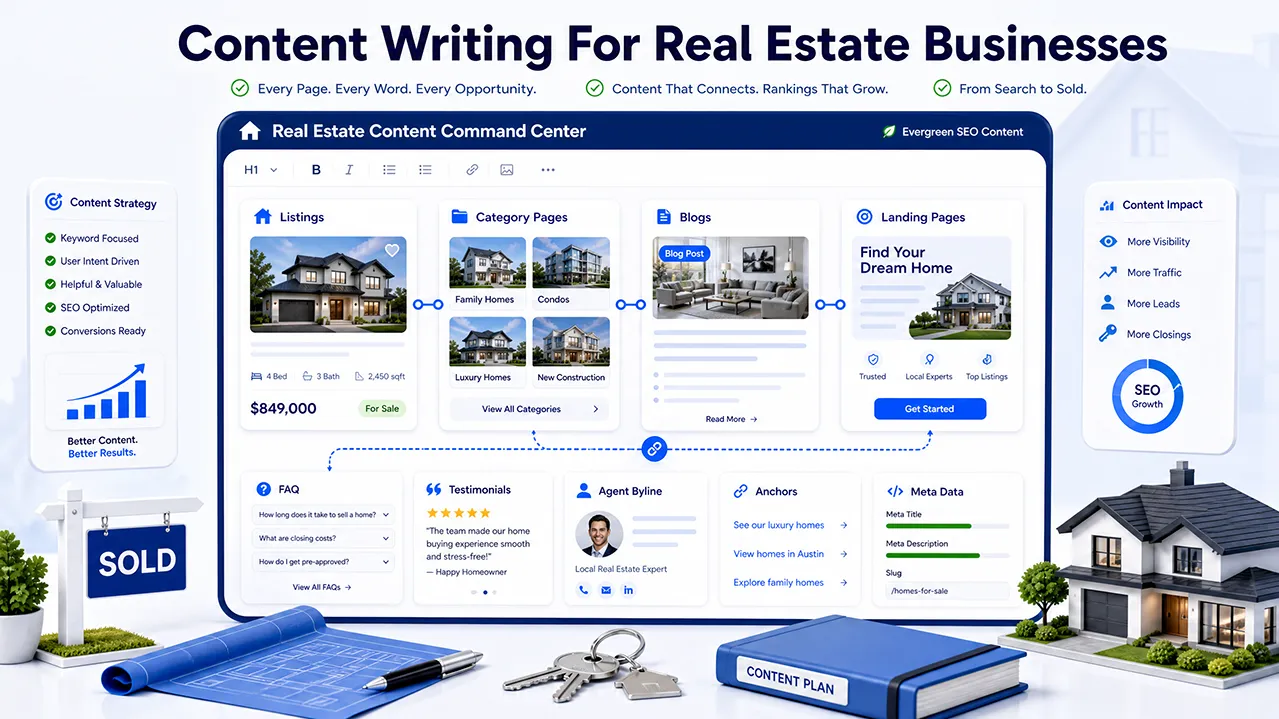
Google and AIs don’t just evaluate the written parts of your websites- they absolutely love to dig into the transcripts of your videos. They can’t “watch” them like a human would, but they can get a good sense of what they’re about from the metadata and transcripts. This can supply a lot of contextual authority.
As almost all of these will be about a specific listing, the principle of ignoring SEO for individual properties can’t apply, and it is worth spending a bit of time thinking about how best to present them.
While these videos are, like the listings they cover, fairly transitory, they can help build up your channel’s authority and improve the rankings for later videos.
Transcripts
Because the AIs and search engines can’t actually sit and watch your video content, it’s important to narrate your property tours. Mention all the things you would on an average viewing, but don’t forget to localize the content by mentioning the area. This can be easy to forget if you’re used to showing people around who know where they are. In fact, it’s usually a good idea to mention the full address, area, and city right at the start of your tour.
It’s also worth going through the transcripts and subtitles manually. While YouTube will autogenerate these, it’s not very good at dealing with accents, and they often need a lot of editing before they’re really useful. These are the best way of including keywords, so it’s well worth investing the time to do it properly.
Video Meta-Data
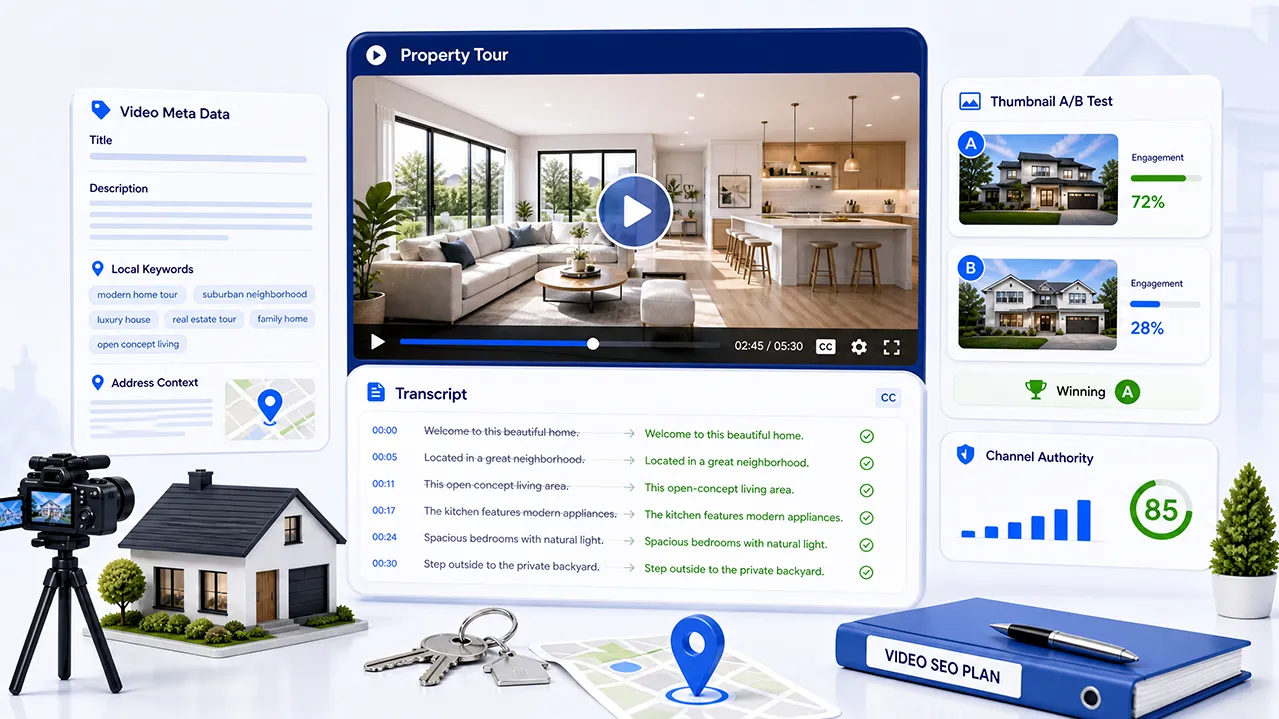
Just like your written content, how you present your meta-data can have a huge impact on how easy it is to find your video content. The key here is including the relevant keywords and being really quite specific.
For titles, it’s generally worth giving the address of the property alongside a brief description. This might look something like “Stunning 2 Bed Victorian Midterrace, 123 Morningside Drive, Edinburgh”.
The descriptions can be even longer and more keyword-rich. For that same property, this might look something like “Follow us on this virtual viewing of 123 Morningside Drive, a spectacular 2-bed Victorian midterrace with some stunning original features, generous garden and prime location in the heart of Edinburgh’s most exclusive residential area.”.
These have the main keywords “2 bed, Morningside” and “Edinburgh”, and allow you to add a lot of additional context to appeal to viewers and bots alike.
Thumbnails
Thumbnails, the still images that act as a “cover” for your video content, play a huge role in tempting people to click and watch your videos. This, in turn, improves your engagement rates, marking out your content as the type of thing people want to watch.
These should be eye-catching, narrative, and generally tempt your target viewers to click your link above the competition’s. It’s well worth A/B testing your thumbnails to see what gets you the best results in terms of branding and, once you’re happy with the number of views you’re getting, sticking to that formula.
Common Problems With SEO for Real Estate Businesses
While SEO is a fantastic marketing tool, offering the best ROI and absolutely huge potential traffic, it’s not without its problems, especially for Your Money or Your Life categories like real estate.
The single most common issue is that it simply takes time to see results. Where PPC ads might see a huge influx of traffic almost immediately, SEO is a longer game. It can often take between 3 and 9 months of concerted effort to really see measurable results.
There are no shortcuts around this (and those that people sometimes try to find often result in penalties for gaming the system). Building authority and showing your expertise simply takes time and consistency. Trust that the results will be worth the investment.
Secondly, for high-stakes investments like real estate, Google places much stricter controls over what is and isn’t acceptable in your content. When you consider that people might be investing their life savings and the results of a bad deal could be life-changing, this isn’t unreasonable. It does mean that you’ll have to put in more time and effort than some other businesses, but at least you can rest assured that the results you offer will be good.
Conclusion: Why Local SEO is the Right Solution for Real Estate Marketing
Search engines and AIs are how people go about gathering information before they make their decisions, and SEO is the way that you can make sure you’re there to guide them through these big choices.
Your clients know where they want to buy a home, run a business, or sell their property, so targeting them in these locations means that you’ll be the one they find when it’s time to make a deal.
