

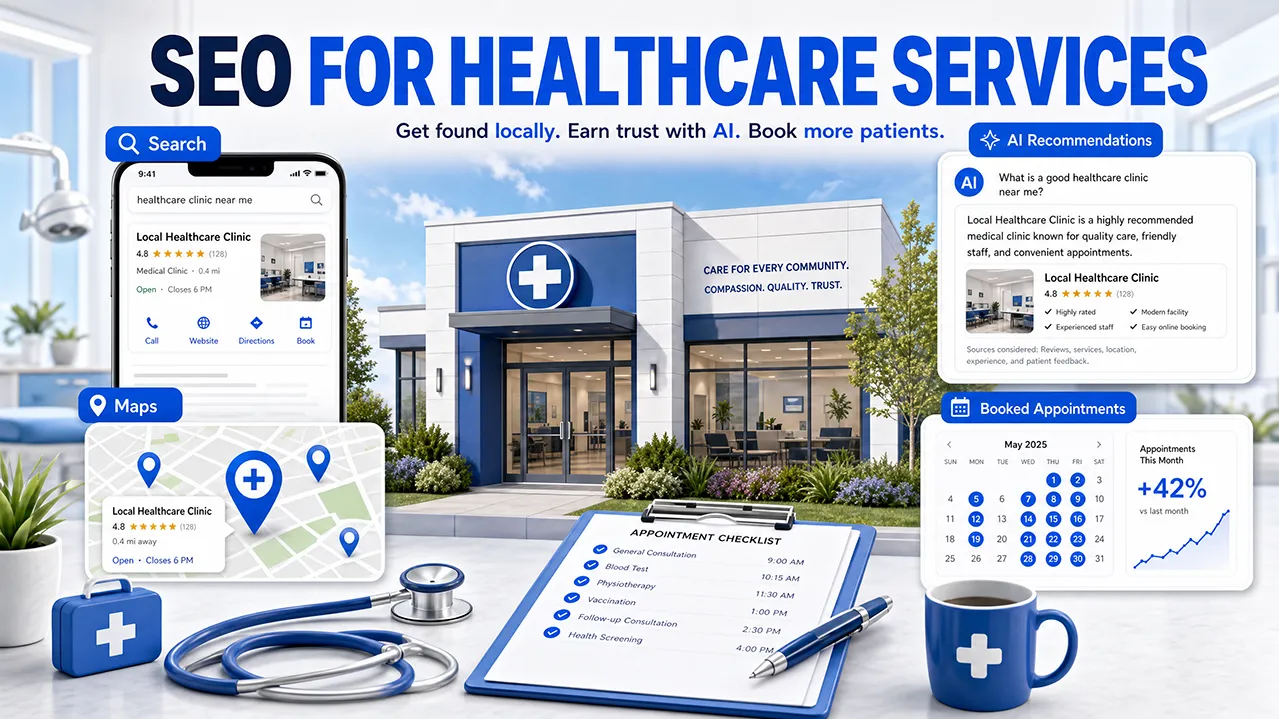
Healthcare is a hugely varied industry, ranging from local GP surgeries to specialist clinics whose patients might travel from across the country or even further afield. For the vast majority of healthcare providers, though, their business comes from their local area.
The easiest way to connect with these potential patients is through search engine optimization. This puts your clinic front and center when they need you.
Estimates say that around 53% of all web traffic comes directly from search engines. Around 50% of all searches on Google are for local services and information, and 97% of clicks on search engine results come from those who rank on the first page. Put simply, SEO matters.
Planning An SEO Strategy For Your Practice
Once upon a time, SEO was simply a matter of repeating certain keywords more often than your competitors. That’s no longer the case, and things are a lot more interlinked and complex than they once were.
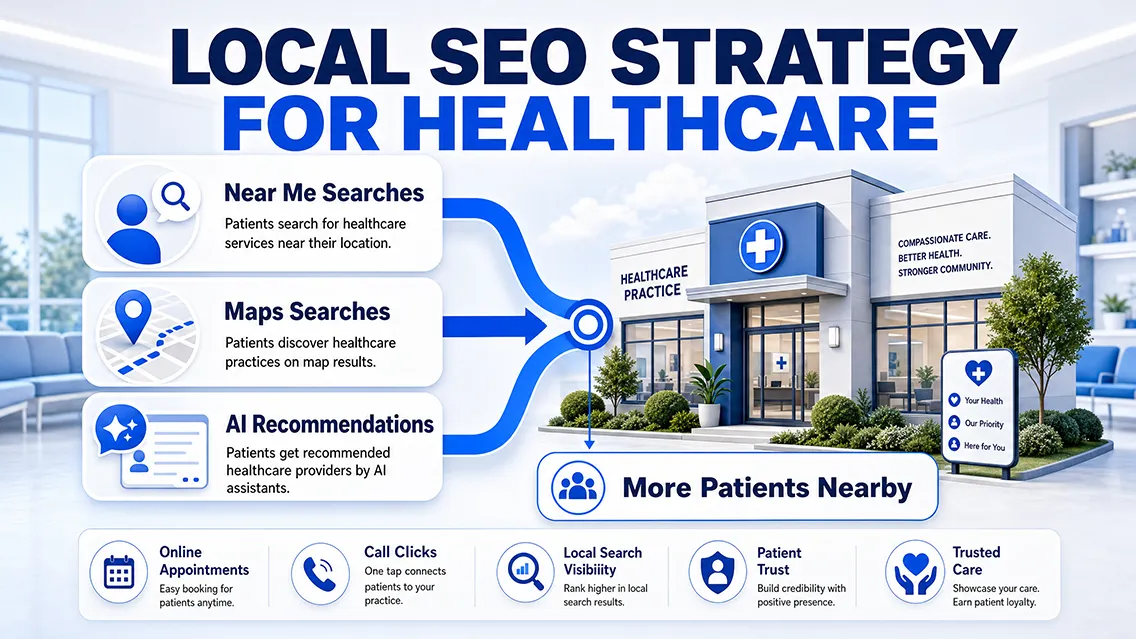
In almost every case, clinics and surgeries should prioritize local SEO when developing their digital marketing strategy. This means that when your patients are searching for a new healthcare provider, you’re the one that they find first.
There are 3 areas of SEO that come under the “local” heading:
- Near Me Searches - These are the traditional searches that your patients are putting into Google or other search engines, looking for clinics nearby.
- AI Recommendations and Mentions- AI summaries now feature in around 25% of traditional searches, and even more people are turning to chatbots for advice.
- Maps Searches- Google Maps is a fantastic way of capturing high-intent searches, and setting up your Google Business Profile can help with your other SEO efforts, too.
Each of these areas involves a lot of overlapping work, but each also requires its own twist to make the most of your efforts. A comprehensive SEO strategy should take all these types of searches into account.
It’s also worth noting that every business in the healthcare industry is classified as Your Money or Your Life by Google, putting a much more stringent set of criteria in place for anyone who wants to rank.
Google Business Profile For Healthcare Services
Google Business Profile (GBP) is a free and easy-to-use tool from Google that plays an outsized role in local SEO, opening up Maps searches and sending strong local signals for both AI and traditional searches. It also serves as a sort of digital business card, providing your patients with all the key info they need before they click through to your site or call for an appointment.
Setting it up takes a few minutes and, with a little optimization, it can bring in a staggering amount of traffic. In fact, complete and verified profiles are 80% more likely to appear in searches than those that aren’t. The top 3 results (the Map Pack) bring in around 93% more contacts (calls, emails, and website visits) than those in the 4-10 positions.
Getting the Most Out Of Google Business Profile
The first task for getting your GBP up and running is the simplest: all you have to do is claim your profile and verify (either by phone call, email, or post) that you are the owner. Once that’s done, you’ll start to appear in our target searches, but in order to rank well, we’ll have to do a bit more work.
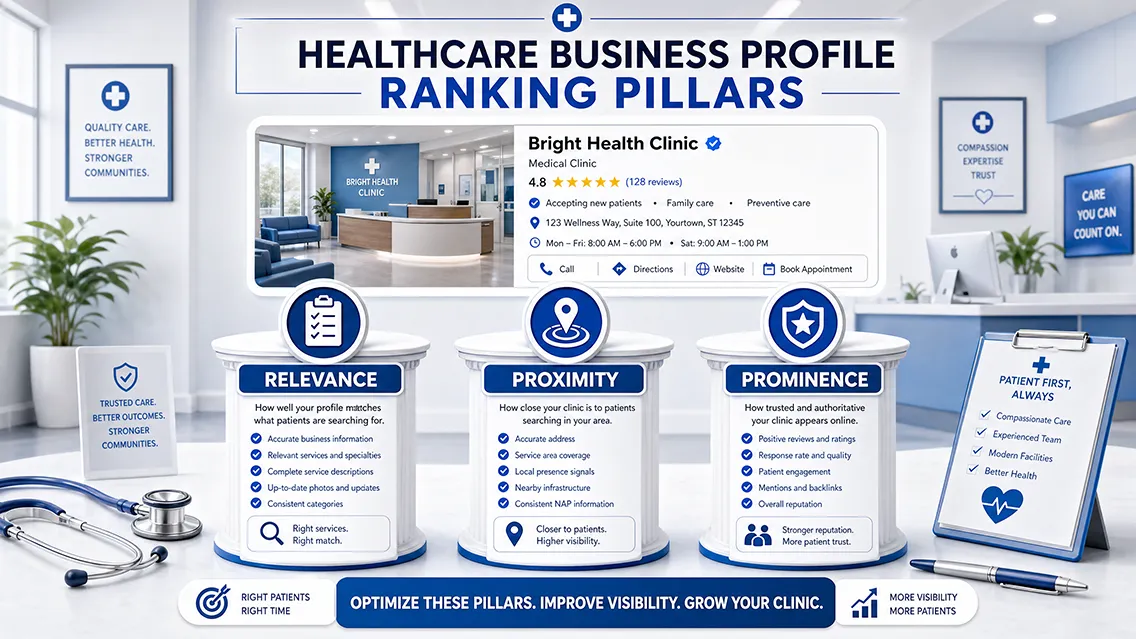
Google uses three main elements to decide which business profiles are a good match for any given search, and unlike traditional SEO, there’s no number 1 spot, as searching from different locations will give different results. These three elements are:
- Relevance: how well the signals that your profile’s content sends match up with the terms and intent of the searcher. This is the area that we have the most control over.
- Proximity: how near to your service area the search was done. We can’t control this, but we can set our profile’s service area to influence which searches we rank for.
- Prominance: A rough measure of how popular your business is with local searchers. We’ve got a bit of control over some of the ways this is determined.
In order for your clinic to appear in the Map Pack (the top 3 results) for the most searches possible, we have to think about how to send the right signals for each element.
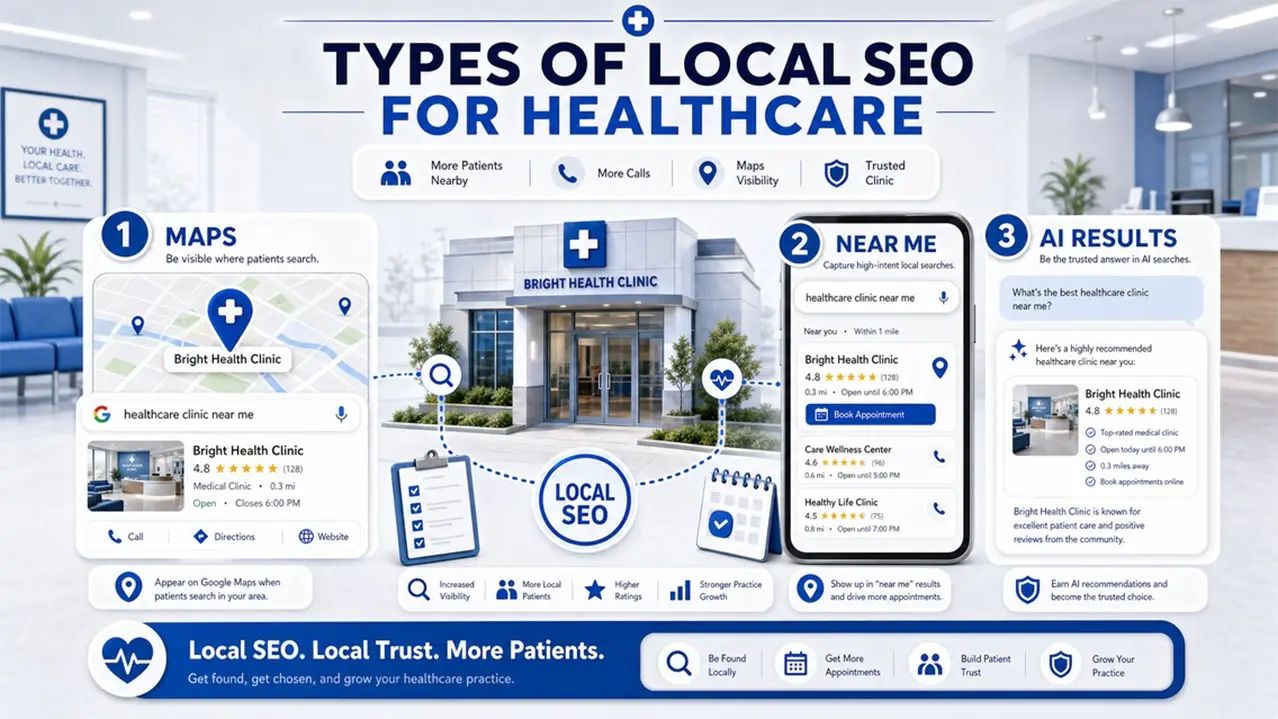
Using Google Business Profile For Local Search Results
Even if you don’t have your own website, there is a lot you can do to optimize your online presence and attract more contacts from potential customers. Google Business Profiles are a fantastic tool for every local business, whether you have a dedicated site of your own or not.
GBPs allow you to appear on local “near me” searches and in Maps. Even if you don’t have a storefront, Maps can be incredibly useful- those who appear in the Map Pack (the top 3 results) can enjoy 93% more enquiries than those who rank 4-10. AIs have also started factoring these in when choosing which businesses to mention.
A lot of these steps will also play an outsized role in how likely AI is to mention your services to people who ask for recommendations.
Setting Up Google Business Profile
Google Business Profiles are free and remarkably easy to set up. They’re probably the single most useful tool for anyone who’s aiming to rank locally and play an important part in getting AIs to notice you, too.
They’re basically a digital business card, containing things like your company name, services, area of operations and a few other details. Perhaps best of all, they allow customers to leave reviews. With 96% of customers saying that they regularly read reviews before choosing a service, this isn’t a feature you want to ignore.
Making the most of your GBP means:
- Claiming and verifying your profile.
- Include a brief but detailed description of what you do. List your services, but avoid going overboard- appearing spammy might see you penalized.
- Set up direct contact options. Customers can call and message directly from the search results, making them taking the first step easy for both of you.
- Include photos- profiles with good quality photos can attract a huge amount more attention than those that miss this step.
- Include your service area- this will help you rank well for the most relevant searches and avoid wasting time with callers from outside your target area.
Relevance
Relevance is the signal that we have the most ability to directly control when it comes to optimizing your Google Business Profile. This is all about how closely your profile’s content lines up with a search term or AI question, and it takes pretty much all your profile’s content into account.
The first thing to do is to select your primary category. This is the single strongest signal that your profile can send, marking you out as what searchers are looking for, often matching search terms exactly. There is a huge range of primary categories in the healthcare sector, so find the one that matches your services most closely. It pays to be quite specific with this choice for most healthcare services.
The next step is choosing your secondary categories. These allow you to get a little more granular and target services more precisely. An example of this might be a therapist's office listing their various specialisms like CBT, counselling, or DBT.
Once your categories have been selected, the next stage of optimizing your profile is writing your business description. This is the ideal place to improve your search relevance by thinking about the keywords your patients are likely to be searching for and including them. While including keywords (and semantically linked versions) is a good idea, avoid the temptation to overstuff them, as this might trigger penalties.
Reviews
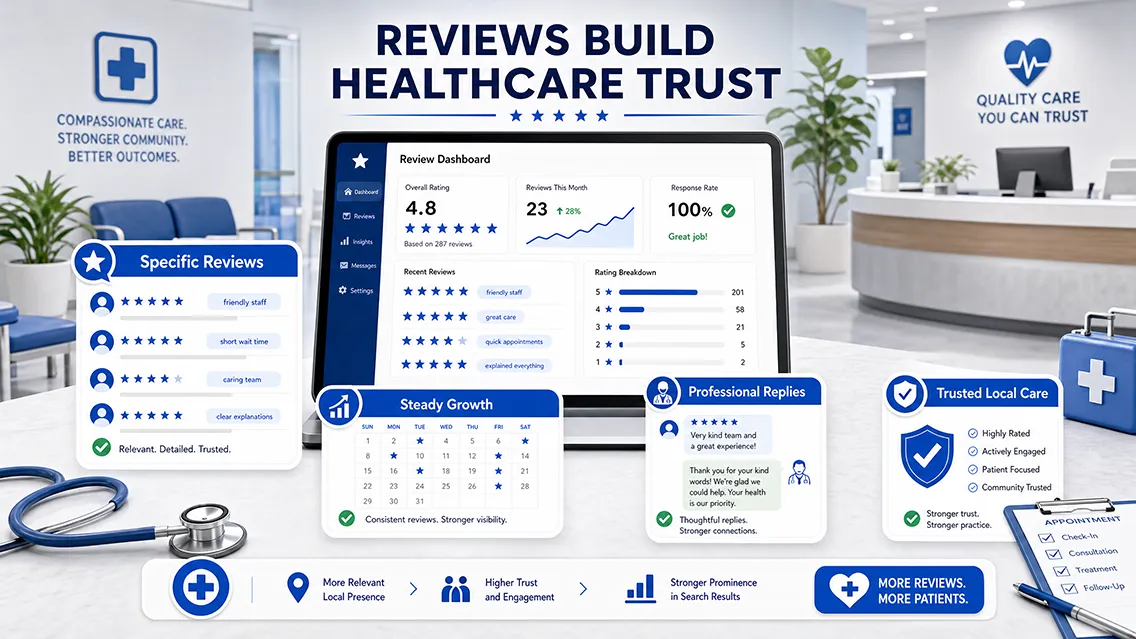
Perhaps the best thing about Google Business Profiles, from your patient’s point of view, is that they allow people to leave reviews and recommendations. 96% of searchers read these reviews before they even consider making contact, so they’re well worth encouraging. They’re also a fantastic way of building both relevance and prominence for your SEO efforts.
The way that reviews are worded can provide a good boost to your profile’s relevance. Let’s say that you’re a podiatrist and most of your reviews mention “podiatry” or “foot pain”. These keywords will help Google and the AIs determine what it is you offer and then serve up your link in the relevant results.
A steady stream of reviews helps to prove that your clinic is an established and respected presence in your area, marking your profile out as a prominent one and a good result for search engines to offer. The more positive (4-star plus) reviews you have, the stronger this signal will be.
It’s worth reaching out to your patients and asking them directly to leave reviews, and it’s always worthwhile responding to each and every one. These are not only your first chance to make an impression on potential clients, they’re a fantastic place to sprinkle in a few more keywords.
Proximity
Proximity is one of the most important factors that Google Business Profile takes into account when determining which clinics are presented at the top of a search result. It’s also, unfortunately, the one we have least control over: you can’t influence where people search from.
Fortunately, proximity isn’t the only factor, and there is something we can do when setting up our profile to help ensure that your practice is shown to relevant potential patients. GBP allows us to set a service area, making it clear where we want searchers to be able to find us from.
You can set this catchment as wide or as tight as you like (coving anything within roughly a 2-hour drive). This feature is particularly useful if you offer home visits, but it can be combined with a traditional Map pin to offer a hybrid solution for those who do have a clinic or practice that they want patients to visit.
Promenience
Prominence is basically a measure of how popular and active Google thinks your business is, judged by reviews and how your practice appears elsewhere online.
Beyond asking patients to leave you (hopefully glowing) reviews, link building with local and national bodies is your best way to signal prominence in the medical field. Because healthcare businesses come under the heading of Your Money or Your Life, the quality of these links matters. Regulatory and industry bodies are the most valuable, followed by things like local media, etc.
Local SEO for Healthcare Providers
The next area of local SEO to start working on is how you appear in traditional “near me” searches. These are the searches like “doctor’s office near me” or “walk-in clinic open now” that your potential patients are entering into Google and other search engines.
Around 73% of all traffic from search engines goes to the top 3 results, so investing time and effort into improving your ranking can offer you a fantastic ROI. While writing content is your main tool here, there are numerous factors at play when search engines choose the order they display results in.
It’s worth noting that, as a healthcare provider, the criteria used to determine rankings are stricter than they might be with another business. Google wants to offer good, reliable results to its users and, not unreasonably, this means that important subjects like health or finances need to be of the best possible quality.
How Does Ranking Work?
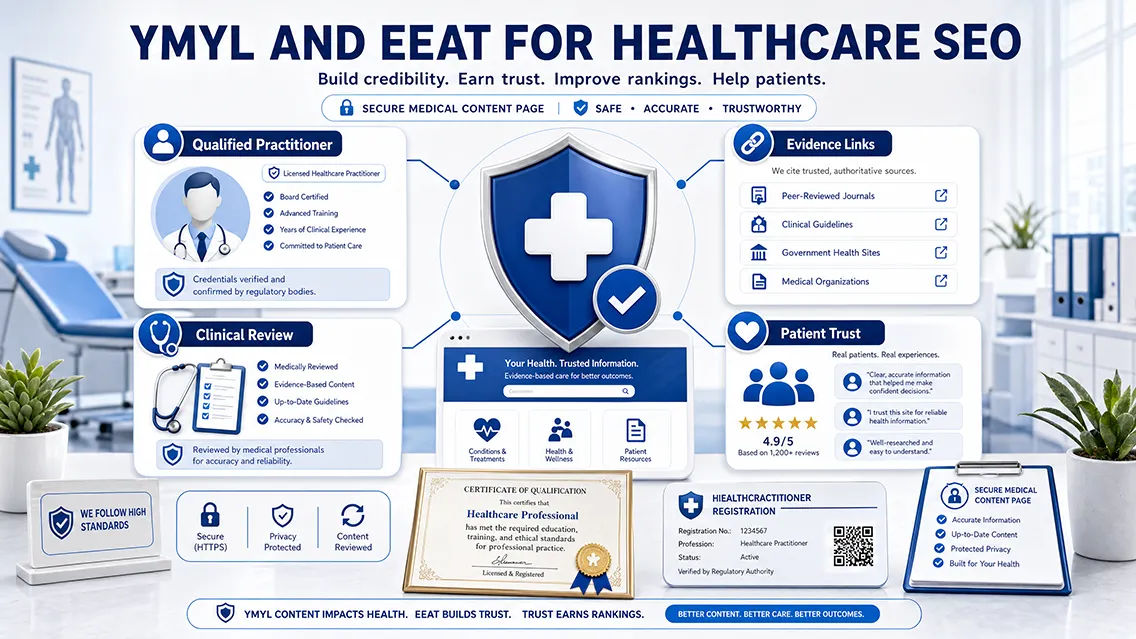
Pretty much all the content online is crawled by bots from the various search engines and then graded using a system we call EEAT (expertise, experience, authority, trustworthiness). Each page on your site will have its own score for each of these areas, and the general rule is that the better the information is backed up and the more human-centric the writing, the better the ranking will be.
Topical Authority
It’s not only your individual pages that are scored for authority, but your whole site will be graded too. This means that all your content and how you appear on other sites play a huge factor in how well you rank. The aim is to become the go-to source for information on your specialism.
Because healthcare is such a high-stakes area, with people’s health and privacy on the line, topical authority is more important for our purposes than it might be for, say, software engineering. Everything we do must prioritize accuracy, depth, transparency, and avoid any chance of misleading readers.
We also need to think about how the site as a whole presents our level of expertise and authority. Linking between pages allows us to spread authority between them, which is particularly useful for ensuring that landing pages rank.
Page Authority
Authority is a measure of how reliable the search engines judge your content to be. There are lots of ways that they weigh this up, but the primary mechanics are about how your page uses links and how other pages link back to your content.
Search engines tend to interpret links as an endorsement. In-coming links (also called backlinks) suggest that your content is good enough that other people want to draw attention to it, while outgoing links suggest that you’ve done your research.
As with everything else in healthcare SEO, quality is more important than quantity. This is particularly true in the age of AI search.
Outgoing Links
You’ve got total control over your outgoing links. These should be scattered around your content, embedded in easily crawlable anchor text (more on that later). They serve as references, building authority by backing up your points with research. They’re free, and you could potentially link to anything.
In the case of anyone working for a healthcare business, some outgoing links are going to be worth more than others. Good sources will be respected medical journals, regulatory bodies, government health agencies, and other reliable institutions.
Backlinks
Backlinks, on the other hand, suggest that your content is reliable enough that other people want to highlight it. These are basically citations and endorsements of your content and can be earned naturally over time as people link to it.
Alternatively, you could reach out to journals, reputable news sites, and regulatory bodies and engage in a little content marketing. Writing content for these sources and embedding a backlink to your own site gives you control, but will often come with a cost.
As we’re focusing on how your site appears in local searches, it’s worth reaching out to local news sources and community organizations to see if they will allow you to link back to your site. This sends a powerful signal of local presence to search engines and AIs alike.
Expertise, Experience, and Trust
The expectations of a medical practice’s site are high when it comes to experience, expertise, and trust, and it’s not unreasonable that the criteria are so strict. We can meet these expectations by ensuring that the content that we write clearly and transparently demonstrates them to search engines, AIs, and our readers alike.
Everything on your site should be written with these three elements in mind, and the best way to do this is to ensure that someone who can prove they know what they’re talking about is involved in the writing process. This means every blog and landing page should be either written or co-authored by a registered practitioner. Use bylines to link back to evidence, such as social media profiles or registration details.
Team Profiles
One way to reinforce your content’s EEAT credentials is to have a dedicated profile page for each team member, then, if they write content for your site, use the byline as a link. This should include a short professional biography that covers their qualifications and specialisms.
These profiles also serve as a way of building trust with your patients, as well as reinforcing the fact that your content is written by someone who really knows what they’re talking about to the AIs and search engines.
Types of Content For Local SEO
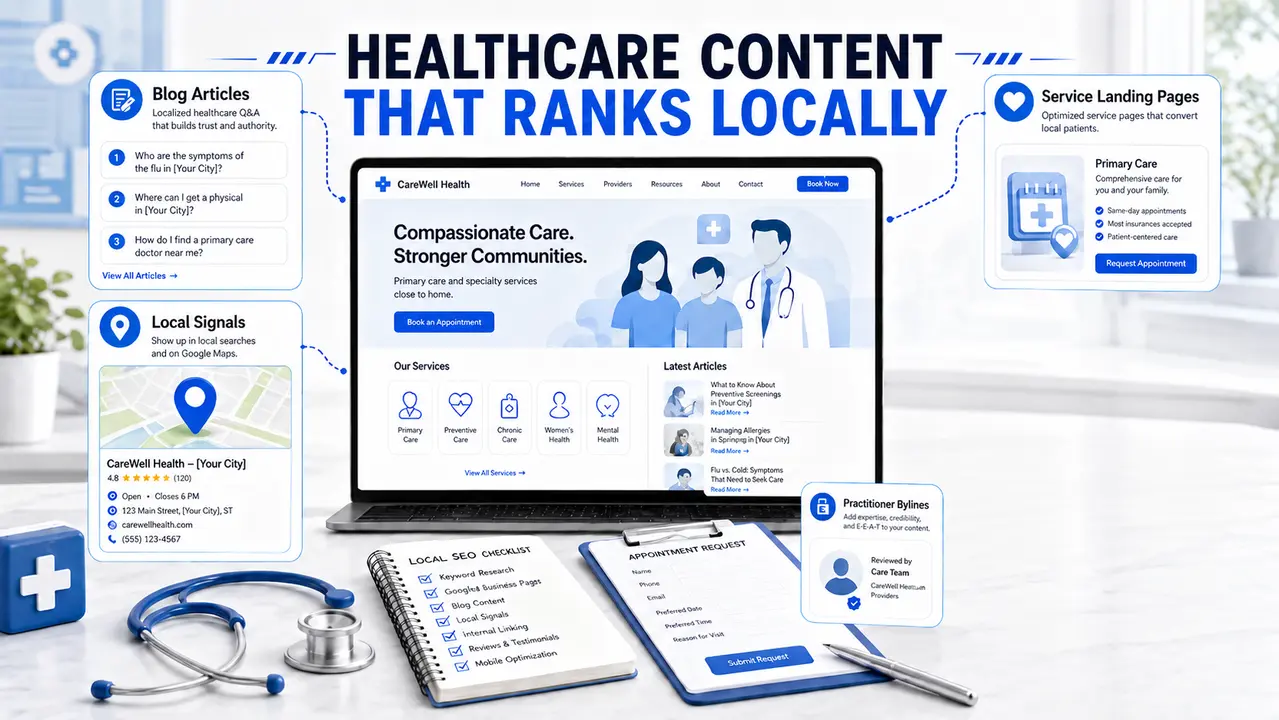
There are two major types of content that your site should contain if you’re looking to improve your local rankings: blogs and landing pages. Whichever you’re writing, your first aim should always be to ensure that it reads well, it’s clear and transparent. This means that it’s useful to the people who are reading it, making it exactly what AI and search engines want, too.
Blogs
Blogs are the easiest way to build topical authority and allow you to really dig into and explore a topic while demonstrating your knowledge and building trust with your readers. In the case of healthcare SEO, these need to be really quite specialized, covering your area and must have a traceable healthcare professional writing them.
In terms of targeting search intent, blogs provide more general information than a landing page would. We can still localize the content, but their main purpose is to offer as much information on a given topic as possible and build authority.
These are great for offering information to potential patients who are considering their options, making them particularly useful for healthcare professionals who specialize in elective treatments, but any medical practice can make great use of them, covering things like general procedures and health tips.
Landing Pages
Landing pages are the more direct, sales-based parts of your site. They aim to encourage people who find them to reach out and make an appointment. They should be shorter, more concise, and describe the service in a little detail.
Each service you offer should have its own landing page, allowing you to target particular searches more accurately. That being said, you might find good results from “registering new patients now” or other more general landing pages that could target searches like “register with a doctor”.
Writing Local Content
As almost all of your patients will likely come from within a set service area, it makes sense to ensure that your content is as localized as possible. In the main, this is as simple as naming your target location as often as possible (without veering into “spam”). Something like “Dunfimline’s Chiropractic Specialists” or “GPs surgery, serving Morningside” is the ideal way to do this.
You should aim for this to be a natural part of your writing. There are a couple of reasons for this:
- Your primary audience is human. People notice when writing is stilted and aiming more for SEO clout than to provide information.
- Search Engines and AI will penalize overoptimized content. Content written purely to stroke the algorithms is generally pretty easy to spot. Penalties can be harsh, especially when people’s health is at stake.
Mobile First
As a local service provider, one key statistic to be aware of is that 60% of local searches happen on people’s phones. This means that we should aim to have a mobile-first design throughout our websites, making navigation easy and improving our engagement metrics.
The primary thing we can do to make life easier for mobile users is to ensure that sites load quickly. 38% of browsers will navigate away if they have to wait more than 7-10 seconds, and 25% won’t even wait 3. This means keeping images to a minimum.
Other quality-of-life considerations might include laying your content out in a single column format, including a call-now button, and making the site generally easy to navigate without the aid of a mouse.
Which Images Should You Use?
With a mobile-first design, each image has to be carefully considered for impact, and the “right” choice will vary from business to business. For some, generic and lightweight is probably the way to go to avoid slowing down loading, while others might have imagery available that helps “sell” the process and is worth compromising for.
For those who work in aesthetics, like plastic surgeons, dentists or anyone with a clear before-and-after process, these make the ideal image choice. These have the potential to help SEO through image searches, too, as people will often search for before/after pictures when considering a treatment.
Off-Page SEO
While the nature and quality of your content is by far the most important factor in determining your local search rankings, it’s not the only thing at play here. Providing search engines and AI with as much information as possible before they parse your content can be very helpful.
Schema Markup
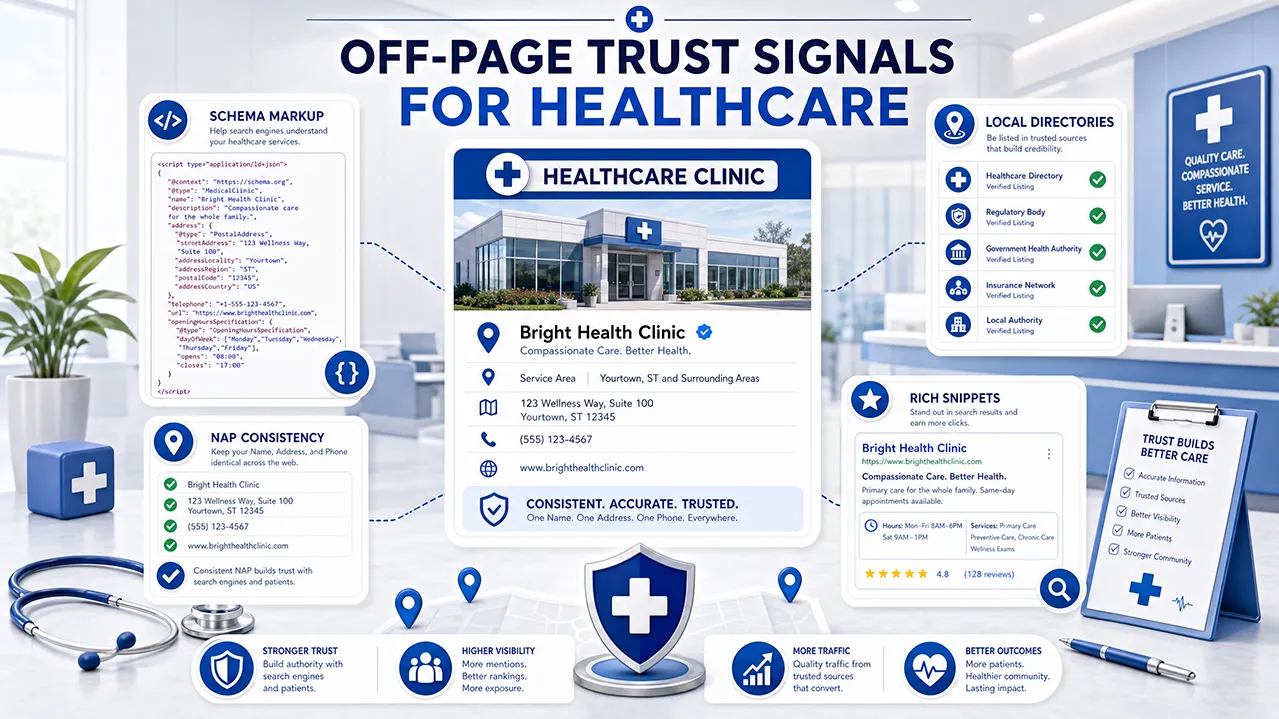
Schema Markup is a simple series of codes that can be injected into the HTML of your site, providing all kinds of useful information to search engines and AIs. This can be used to create “rich snippets”, changing how your page appears in search results to include things like price range, services, opening hours, and other relevant information.
It can also help establish expertise by including information about your team’s qualifications and certificates. This structured data makes the information easy for Google or ChatGPT to understand, increasing their confidence (and your ranking) when they offer your page in their results.
There is a huge range of different groups of Schema Markups, and you should select the most relevant ones for any given piece of content.
Local Listings
Local directories are effectively the digital version of the phonebook, and they play a surprisingly large role in local SEO efforts. Getting yourself listed here sends a powerful signal of locality and prominence.
They provide a high-quality backlink, lending your site a little extra local authority and helping to reinforce your name, address, and phone number (NAP- more in the next section).
There are other useful places to list your business and link to your site as a medical professional, too:
- National Regulatory Bodies
- Government Health Authorities
- Local Authority Sites
- Network Health Insurance Providers
All of these send a powerful set of signals about topical authority and, as they’ll generally have your address and service area attached, also help reinforce your locality, too.
Contact Information
The primary purpose of engaging in local SEO is to tempt potential patients into calling, emailing, and generally making contact to book an appointment. This means that getting your contact information out there should be a main concern.
We refer to this information as NAP (name, address, phone number), but it could be any way of getting in touch. What really matters here is consistency. These should match exactly in every place that they’re listed.
Differences in how these are presented run the risk of putting out confusing signals over your most important information, resulting in search engines and AIs giving out the wrong contact details and potential patients not being able to make contact.
Make sure this is listed wherever it reasonably can be- directories, lists of approved practitioners, your GBP, and your website- it’s the single most important part of the whole process.
Off-Page SEO
While the nature and quality of your content is by far the most important factor in determining your local search rankings, it’s not the only thing at play here. Providing search engines and AI with as much information as possible before they parse your content can be very helpful.
Schema Markup
Schema Markup is a simple series of codes that can be injected into the HTML of your site, providing all kinds of useful information to search engines and AIs. This can be used to create “rich snippets”, changing how your page appears in search results to include things like price range, services, opening hours, and other relevant information.
It can also help establish expertise by including information about your team’s qualifications and certificates. This structured data makes the information easy for Google or ChatGPT to understand, increasing their confidence (and your ranking) when they offer your page in their results.
There is a huge range of different groups of Schema Markups, and you should select the most relevant ones for any given piece of content.
Local Listings
Local directories are effectively the digital version of the phonebook, and they play a surprisingly large role in local SEO efforts. Getting yourself listed here sends a powerful signal of locality and prominence.
They provide a high-quality backlink, lending your site a little extra local authority and helping to reinforce your name, address, and phone number (NAP- more in the next section).
There are other useful places to list your business and link to your site as a medical professional, too:
- National Regulatory Bodies
- Government Health Authorities
- Local Authority Sites
- Network Health Insurance Providers
All of these send a powerful set of signals about topical authority and, as they’ll generally have your address and service area attached, also help reinforce your locality, too.
Contact Information
The primary purpose of engaging in local SEO is to tempt potential patients into calling, emailing, and generally making contact to book an appointment. This means that getting your contact information out there should be a main concern.
We refer to this information as NAP (name, address, phone number), but it could be any way of getting in touch. What really matters here is consistency. These should match exactly in every place that they’re listed.
Differences in how these are presented run the risk of putting out confusing signals over your most important information, resulting in search engines and AIs giving out the wrong contact details and potential patients not being able to make contact.
Make sure this is listed wherever it reasonably can be- directories, lists of approved practitioners, your GBP, and your website- it’s the single most important part of the whole process.
Where Should Healthcare Services Get Backlinks From?
As we’ve already mentioned, backlinks are the primary source of domain authority. These are the links, hosted on other sites, that point towards your content and send signals to search engines and AIs that your information is valid and useful.
For anyone in the healthcare sector, from doctors' surgeries through therapists and acupuncturists, the quality of these host sites matters more than the number of them. A few, well-placed backlinks will do more good than dozens of lower-quality links will.
Some of these links can be earned naturally. Simply write good quality content, and people will, over time, want to point their readership towards your content. This is a slow and uncertain process, though, offering you no control at all. The alternative is content marketing, which deals with both of these issues.
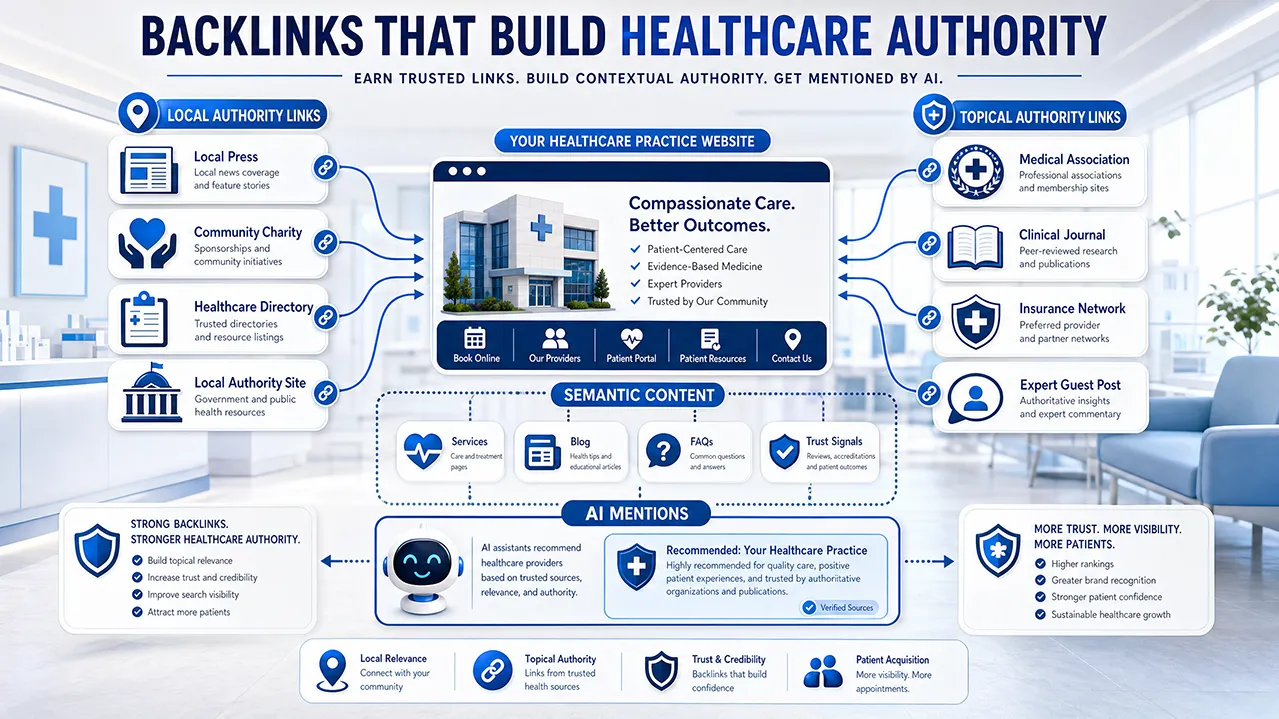
There are two types of backlinks that will be helpful in improving your local SEO: local links, which reinforce your geographical location, and topically relevant links, which enhance your expertise and authority metrics.
Local Link Building
Building links that reinforce your position in the community is perhaps the easiest form of link building for healthcare businesses. We’ve already covered a few of the most obvious sources: local directories and similar lists of practitioners in a given area.
There are other useful, high-authority sources of backlinks available that will send localization signals to AIs and search engines. Local press are often looking for quotes and might be happy to offer a link in return. Likewise, partnerships with local charities and organisations like schools could be invaluable.
Topical Backlinks
Slightly trickier, but even more valuable in terms of meeting Google's Your Money or Your Life rules, topical backlinks exist to prove your authority to speak on a health-related topic. These play an outsized role in determining if your content gets picked up by AIs or is ranked highly by search engines.
The best sources for these tend to come from you reaching out to a relevant, high-authority site, such as a medical journal, national association, or other respected body, and offering to write content for them.
That being said, simply having your practice listed on the relevant national database will generally provide a very high-quality backlink, signalling that you are respected enough to be a registered member in good standing.
It’s also worth pointing out that these links, as well as being great for your SEO, can directly lead to traffic visiting your site. If they’re interested enough to read your piece, they’re probably interested enough to make contact.
How to Build Backlinks for AI
Quality of backlinks is always more important than quantity, but this rule is especially true when it comes to being mentioned by AI. While everything we’ve discussed already still applies, we need to think more carefully about how the meaning of the content we’re linking between matches, as AI places a lot of emphasis on these contextual links.
This is known as semantic linking, and it matters far more than selecting a particular piece of text as an anchor when it comes to getting AIs to mention your practice in their answers. For example, if you’re writing a guest post about acupuncture for pain relief, a link to your acupuncture landing page will be more useful than one that points to your homepage, as these are more closely semantically linked.
It’s often worth running a few relevant queries through a chatbot that you’re particularly targeting and noting which sites it draws on for its answers. These sites will already have been crawled, graded, and deemed to be high-quality. If you can offer a guest post to one or more of these, your chances of getting mentioned in return are much better than other options.
Choosing Keywords For Healthcare Content
Keywords are the most basic part of any SEO strategy, representing the search terms (or a close semantic link) that your targets are entering into their search bars or AI chats. These send the signal that your content is relevant to their search and, therefore, is worth ranking well.
Once upon a time, SEO was mostly the art of stuffing your target keyword into your content more times than your competitors. Today, things are significantly more involved, and this historical strategy is likely to see you knocked down the rankings rather than rising up.
These targeted words and phrases should be scattered throughout your content, aiming to bring in the relevant searchers, but using them naturally is far more important than using them repeatedly. In fact, simply repeating them again and again is likely to signal overoptimization and lead to a loss of ranking for attempting to game the system.
Finding Keywords
The first step towards deploying keywords in your content is deciding which search terms and AI queries you want to target. Brainstorm a few “seed” ideas which are related to your particular field of healthcare, and think about what people might be searching for when looking to make an appointment.
You could then search for these terms yourself and try to work out exactly how those pages that rank have used them, or, alternatively, you could turn to a keyword research tool. These do all the heavy lifting for you and provide you with fairly detailed data about who ranks for what and how hard it will be to compete.
Balancing Metrics
Keyword research tools will break down their results into three main metrics:
- Volume: an estimate of the number of searches done for that particular keyword each month
- Difficulty: the average authority score your competitors have for their pages that rank for that keyword
- Competition: how many sites are competing to rank with that keyword.
The basic aim of SEO is to get to the highest possible ranking for the largest volume of searches possible. However, this doesn’t always mean that you should put all your time and effort into chasing the single highest-volume keyword.
It’s usually fair to say that the highest volume keywords also have the highest difficulty and competition scores, and it simply might not be possible to rank well for them. The first result on any given search tends to get around 39.8% of the clicks, on average. This means that it’s often more sensible to aim for a larger slice of a smaller pie.
Instead of chasing the largest search volume, a more sustainable approach might be to compromise and aim to balance volume with competition and difficulty. You might appear in fewer searches, but you could bring in more visits and book more appointments.
That being said, sometimes it will be impossible to avoid using the highest volume keywords- it would be hard to run a therapeutic massage clinic without mentioning “therapeutic massage” relatively often. These keywords can be targeted through combining them with locations, using synonyms and other techniques, like including “emergency” and “open now” with your service descriptions.
Another important set of keywords, especially for healthcare professionals in the US, will be the names of insurance companies that you work with. These will be searched for almost as often as the service itself.
How to Use Keywords
Now that you’ve identified your keywords, it’s time to put them to use. They should be scattered throughout your content, bringing people and AIs to the relevant pages that match their search intent best.
Search intent can be broadly broken down into two categories: informational searches and transactional searches for services. Keywords are your best tool for making sure that the content people are served is the one that best matches their intent.
- Informational Searches: people looking for a little more information about their options and the benefits of a certain treatment. Target these through less “urgent” keywords, such as “why consider seeing a nutritionist?” or “what is functional medicine?” and direct them to the relevant blog.
- Transactional searches: people looking to register, book an appointment, or generally directly engage with you. Keywords here should be more localized and focus more on a specific service, bringing traffic to a dedicated landing page which aims to convert them.
Whichever search intent you’re targeting, the key thing to understand is that deploying keywords is a balancing act. You want to include them often enough that they send strong relevance signals to search engines and AIs, but you don’t want to overstuff them and run the risk of being demoted for overoptimization.
All your content must read naturally. You wouldn’t say the same phrase verbatim 5 times in a normal conversation, so don’t do it in your content. Luckily, there are usually alternative ways of phrasing something that can be equally useful.
Semantic Links
Rolling on from that last point, search engines and especially AI are not as simple as they once were. Rather than simply taking a keyword as a distinct, separate unit as they did in the past, they now group them together into broader categories of related terms and phrases.
We call this latent semantic indexing (LSI), and it serves two purposes:
- It allows AIs and search engines to get a better understanding of your content. A blog that contains “hearing loss”, “hearing aid”, “deafness”, “behind the ear” “, in the ear” and “receiver in the ear” is probably about the different types of hearing aid and likely to be a good result to offer when someone searches for “hearing aid types”.
- It allows variety in how you write. This means that you can include alternative names for your services and related terms, making your content more natural, useful and helping avoid penalties for being “spammy”.
Your primary audience should always be the people who are actually reading your content, and including LSI keywords and phrases means that you can keep them engaged while improving your SEO. Simply repeating the same terms over and over again will put readers off, so mixing it up can really help with engagement metrics.
While LSI keywords are important for search engines and human readers, they’re even more valuable for AIs. Modern chatbots thrive on semantic linking, as it allows their answers to be more confident and much more conversational.
Longtail Keywords
Not all keywords are a single word. In fact, you may find more value in targeting longer, more conversational search terms. These are particularly useful if your main goal is more mentions from AI or people using voice assistants, but they’re always good to include.
A longtail keyword is a naturalistic phrase that contains both the main keyword you’re targeting and some extra descriptive context. For example, “Dublin’s sports therapy specialists, specializing in therapeutic massage and more” targets:
- Location
- Service
- Sports therapy
- Sports massage
These are all what we would call “high-intent” searches- people who look for these online are very likely to be looking to make an appointment. This means that capturing these results should be your priority.
Keep it Targeted
While it might be tempting to write one super-page, containing as many relevant keywords as you can possibly fit in, this is a bad idea for a few reasons.
Firstly, people are searching for solutions or information about a specific problem, especially when it comes to their health. Someone with a sore knee doesn’t need to wade through 1000 words about back injuries, even if you could help them with both. They want a solution to their sore knee. If they’re not presented with that fairly quickly, they’ll click away and look elsewhere.
Keeping keywords fairly closely targeted means that when people have a problem, you can target it and offer the relevant solution. This means that the traffic you get will be far more relevant than if you’d targeted things more generally.
Finally, search engines don’t like pages that don’t offer useful, human-centric content. If you overstuff your keywords, you may even trigger some pretty harsh penalties for appearing “overoptimized”.
How AI Uses Keywords
While keywords are still important for earning AI mentions and citations, they’re treated a little differently. While everything we’ve already mentioned still applies, AIs place far more importance on the semantic meaning of your content than matching a particular phrase.
While you’ll still have to include your keywords (and their semantic links-the more the better), it’s far more important to actually offer answers to the questions people are asking their favourite chatbots. By providing an answer that the AI can use, they can then present this confidently to their users.
It’s often worth actually asking the question itself in your headings, then using the body text to answer. Structuring your content this way means that you can fit in your keywords and provide an easy-to-parse structure to earn AI mentions.
Writing Healthcare Content for Local SEO
There are two types of content that are useful for improving your rankings and earning visits from potential clients: blogs and landing pages. As we’re talking about healthcare services specifically, both of these must be of the highest quality to reassure search engines and AIs that they’re good results to offer.
Blogs
Blogs, like the article you’re reading now, are longer, informational pieces of text that seek to explore a topic in a little depth. In terms of your readers, they help to build trust and prove your level of knowledge on a subject and can be used to “soft sell” your services, though this is secondary.
In terms of SEO, the main purpose of blogs is to tempt these informational searches in while building authority, which can then be shared (through internal linking) with your landing pages. They’re also by far the best chance you have of earning a mention from ChatGPT or other AIs.
How you write them will vary from topic to topic, but the general rules are:
- Write in an inverted pyramid: basic answers at the start of your section, expanding into more nuance and detail as you go. This is useful for both your human readers and the bots.
- Back up your points using links: links to high-authority sites allow you to piggyback on their ranking, offer reassurance and more information to readers and tell both search engines and AIs that you’ve done the work.
- Ensure a registered practitioner is involved in writing them: as healthcare comes under Your Money or Your Life rules, it’s vital that authorship is attributed to a real, verifiable practitioner.
Landing Pages
The other main type of content that works for SEO purposes is landing pages. These are short, punchy and, above all, persuasive. Their whole purpose is to turn search results into appointment bookings.
Each service that you offer should have its own dedicated landing page, where you present the solution to specific problems. Include as many relevant details as possible, like price ranges, reviews and specific benefits of a particular treatment, but keep it short and precise.
The authority of landing pages can be boosted by linking to relevant blogs on your site. This is great for spreading authority around and offering a more detailed overview of a particular treatment to your readers.
FAQs
Including FAQs is a fantastic way of directly engaging with your audience’s questions, and they have a comfortable home on both blogs and landing pages. They can provide a lot of extra information without making your content too dense and offer you the perfect way to build even more contextual authority and include more relevant keywords.
FAQs are particularly useful when targeting AI mentions. The simple structure of a heading tag question followed by an explicit answer is exactly what they’re looking for. This structure stands out clearly to AI crawlers as something they can present to their users as-is.
Writing Content For AI
Writing for AI is, handily, very similar to writing for human consumption. They value conversational, easy-to-read pages that actually seek to address concerns and offer valuable information and insights, just like people do.
There are a few structural tricks that make content particularly stand out to AI crawlers:
- Sectional Headings: use these to ask the questions that your clients are likely to be asking their chatbots.
- Inverted pyramid structures: answer the question simply first. If someone stops reading after your first line, they should still come away better informed than they started.
- Make use of lists and bullet points: these can be quickly and easily understood.
- Use tables: if you’re comparing things directly, a table could be the clearest way.
These are all useful for any AI interaction that you might be targeting, but they particularly stand out as methods for targeting Google's AI search summaries. 87% of people read these summaries, and around 50% then go looking into the sources, so targeting them makes sense.
As AIs can only generally pull from about 5-8 sources for their answers, your on-page EEAT is even more important than it is for traditional SEO. It’s worth reasserting your credentials whenever you can, so long as the content still reads naturally.
Anchor Text
As we spoke about in the section about building authority, how you choose and present your outgoing links has an impact on your rankings, especially in Your Money or Your Life subjects like healthcare.
We call the text that’s highlighted, telling people that a link is embedded, “anchor text”. There are various ways that you could choose which words to highlight:
- Exact Match: As you might guess from the name, this means choosing an anchor that exactly matches a targeted search term. Having a few of these is good, but keep numbers low (about 10%) to avoid appearing overoptimized.
- Partial Match: A partial match anchor contains the keyword but also has a little more context highlighted.
- LSI Anchors: AIs and search engines are good at grouping terms together into semantic folders. This means our anchors don’t have to contain a particular word to help in ranking for it, so long as the text is semantically similar.
- Naked URLs: An anchor that isn’t attached to any particular text. These don’t offer any context but still spread authority. In the case of healthcare, they’re generally best used as footnotes, giving the impression of an academic essay.
- Branded Anchors: An anchor embedded in a brand name. These are useful for any products or branded services you mention, but could also be any other groups which you work in partnership with.
The best approach to anchors is to ensure that you have as varied a profile as possible. Overreliance on any particular type might risk sending overoptimization signals to search engines and AIs and reduce your rankings rather than improve them.
Where you place these links is an important factor when dealing with traditional search- their position influences how easy it is for their crawlers to make sense of your content. For AIs, the position is less important than how the content you’re linking to relates to your own writings, so longer, more descriptive anchors are more valuable.
Meta-Titles and Descriptions
Meta-titles and meta-descriptions form the basis of how your content will be displayed on search results pages. The general rule is that they should be short, descriptive of the content people will find if they choose to click and tempting.
Meta-titles are what Google and other search engines will use as the anchor text on their SERPs. There are no hard limits on how long they can be, but only 600 pixels (around 50-60 characters) will be displayed.
You should include your main target keyword in your meta-titles, but be careful not to push into spam territory, as you still have to tempt users to click your link with the offer of quality content and an actual answer to their query. They should be different from your H1 tag, but offer basically the same information.
Meta-descriptions, on the other hand, can be a bit more detailed (though they should still be short and punchy). These usually form the basis of the text under the link (though sometimes Google will generate something from your content or mix and match between the two).
They should also contain your keywords and be descriptive, explaining what people will find if they follow your link.
Problems with Healthcare SEO
SEO is a great marketing tool, allowing you to bring in a lot of high-intent traffic, but it’s not without its problems.
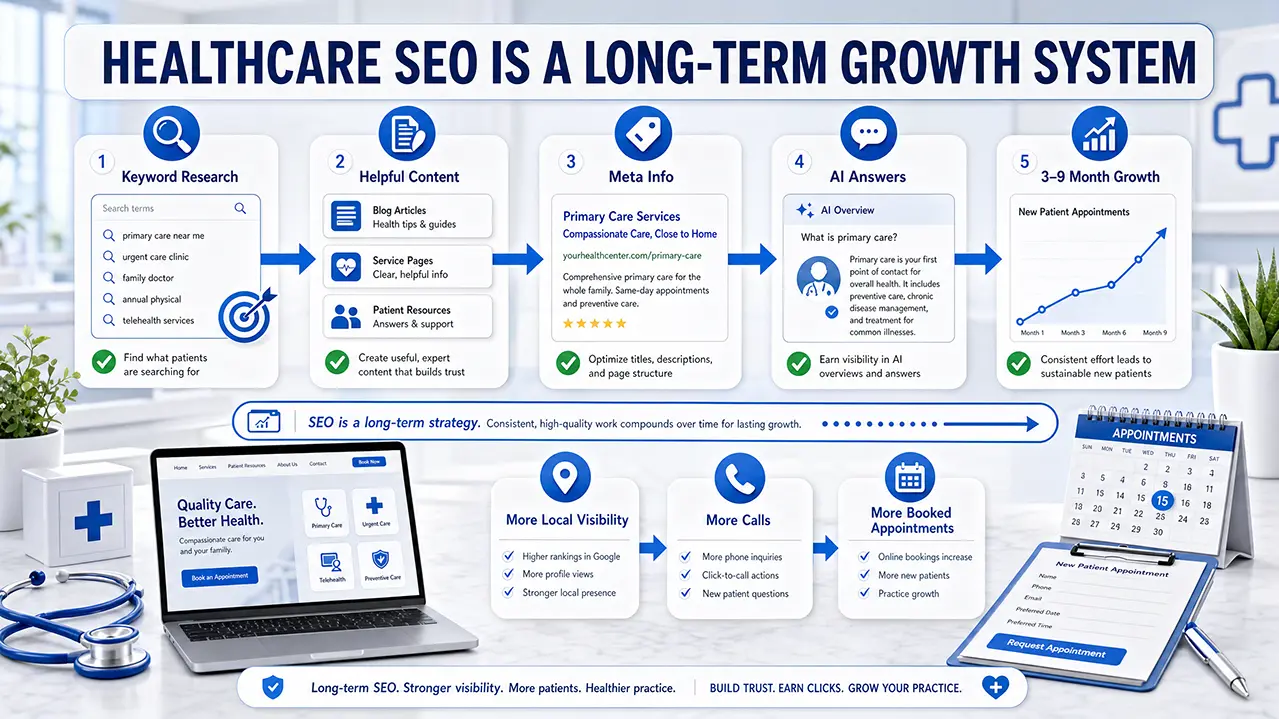
The first problem applies to all SEO efforts, especially those being undertaken by newer firms- it is not a quick process. It’s not uncommon for companies to have to wait between 3 and 9 months for real, measurable results to show.
There are simply no shortcuts around this- it takes time and effort to build authority and demonstrate your expertise- and, more often than not, trying to find the easy answer will simply result in penalties being applied for trying to manipulate the system. The only solution is consistency and constant refinement of your efforts.
The second problem is that Google places much stricter criteria over sensitive areas like healthcare. You’re dealing with sensitive information and potentially life-changing results, so this isn’t an unreasonable burden, but it does require more effort than some industries need.
All your content has to be open, honest and transparent. The people writing it must know what they’re talking about and be able to demonstrate it with their online presence.
That being said, SEO is generally the best value marketing tool available, offering fantastic ROIs for those who take the time to invest in it properly.
Conclusion: Why Local SEO is the Answer For Healthcare Services
Put simply, your clients are turning to Google and ChatGPT with their health concerns, and you are the source of their answers. While it might be nice to appear in the top-ranked spot for a search from the other side of the country, those people are pretty unlikely to book an appointment.
Your patients are in your local area, so focusing your efforts here means that when they’re looking for treatments, it’s you that they find first.
