

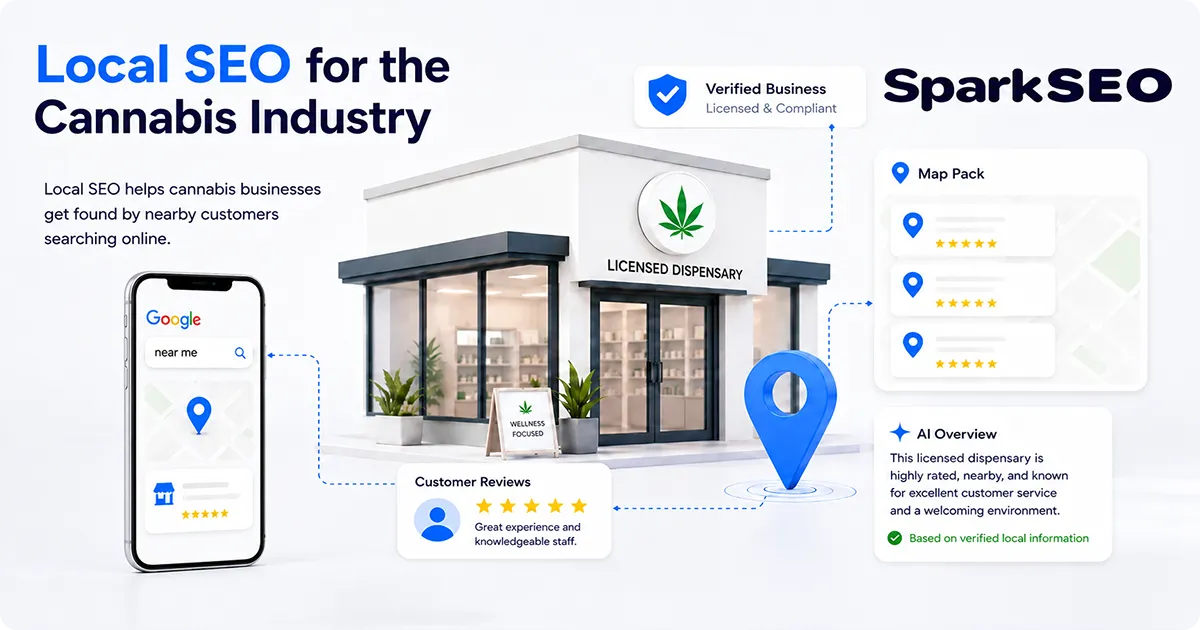
With the legalization of commercial weed sales and medical cannabis across various locations across the US, Canada, and Europe, a whole new industry has been born in recent years, and that means that a whole new school of digital marketing has risen alongside it.
Thanks to the laws governing commercial sales varying widely from place to place, the exact way you approach your digital marketing will differ depending on where you run your dispensary or social club, but there are a few general rules that will help any business grow (excuse the pun).
What Is Local SEO?
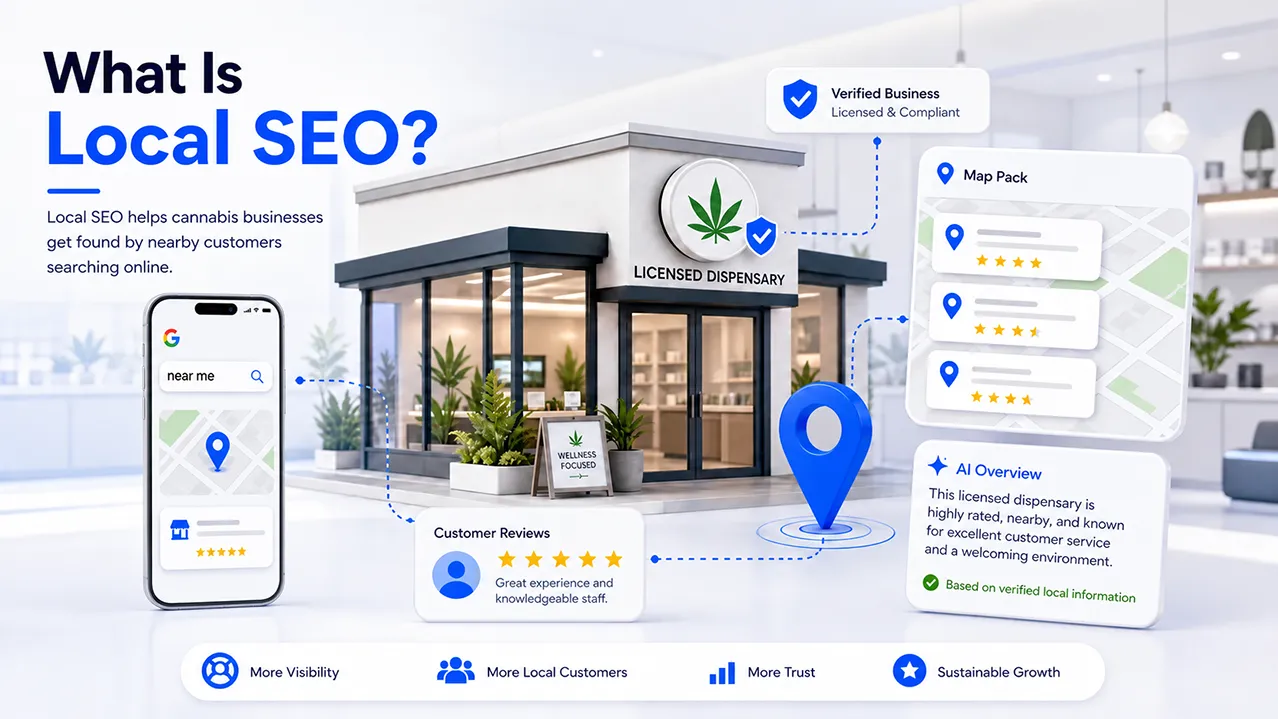
Local SEO, as the name suggests, is the art of ranking in various search results based on location. Once upon a time, this was simply a matter of naming your target area in your texts as often as you possibly could, but today, there are a lot more moving parts to consider.
The Three Areas of Local SEO
Local SEO can really be broken down into three distinct areas:
- Maps Searches- People looking to visit your store. In fact, around 80% of Maps searches end up in a physical visit.
- Local Searches- these are the “near me” searches that lead to website visits and businesses appearing in the “Places” section of Google results.
- AI recommendations and mentions- These have become a serious consideration very quickly- Somewhere between 48% and 55% of all searches now come with an AI summary, and 60% of users say they find everything they need here.
While all of these types of searches are closely linked and play into each other with much of the work that goes into ranking overlapping, each also has its own criteria that need to be addressed.
Today, we’re going to cover the elements you can do before you start writing blogs and landing pages- in fact, this can all be done without setting up a dedicated website at all. For more details on on-site SEO for the cannabis industry, check out our dedicated blog here.
Why Focus On Local SEO for Cannabis Sales?
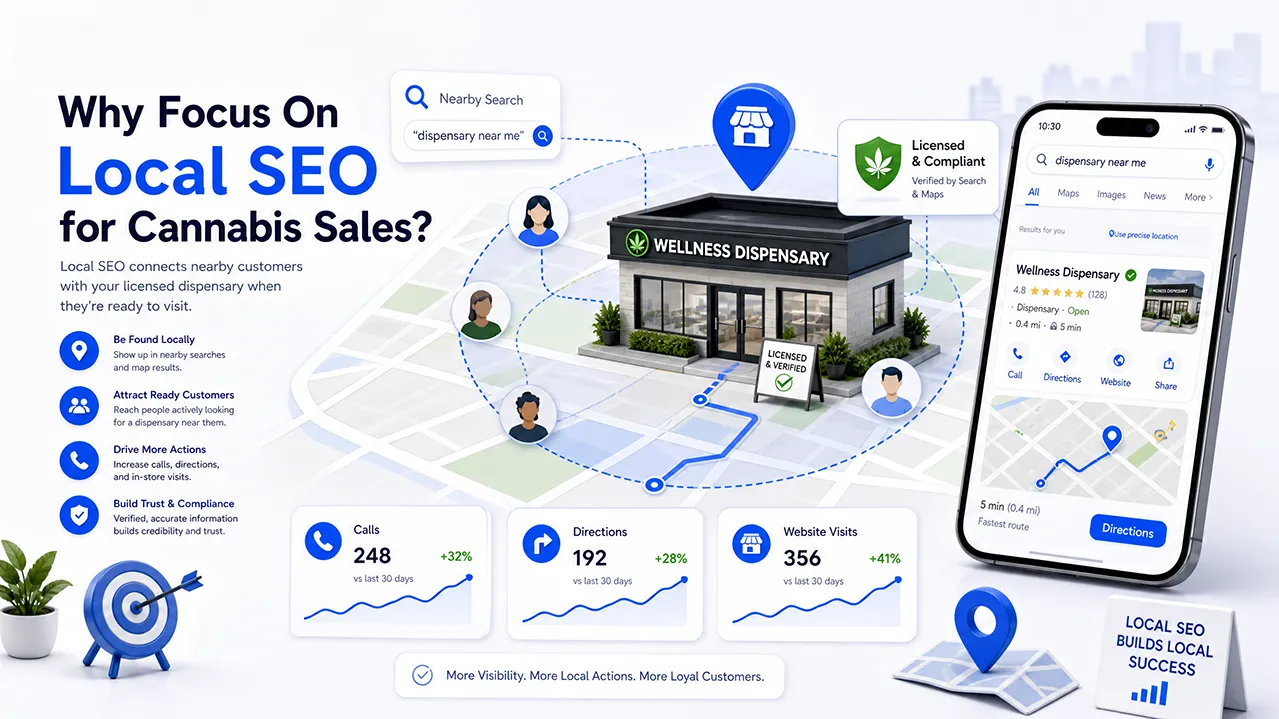
Cannabis is, at its heart, a local business- most locations that allow commercial sales or non-profit social clubs only allow in-person sales through licensed, regulated dispensaries, and even those that do allow deliveries place strict local controls on the process.
Focusing on Local SEO lets you target your customers directly. By giving yourself the best possible chance of appearing in the relevant local and Maps searches, when it’s time to buy, it’ll be you that they find. This even applies if you run multiple locations- it’s still the local dispensary or club that people will come to.
The First Step: Setting Up Google Business Profile as a Cannabis Dispensary
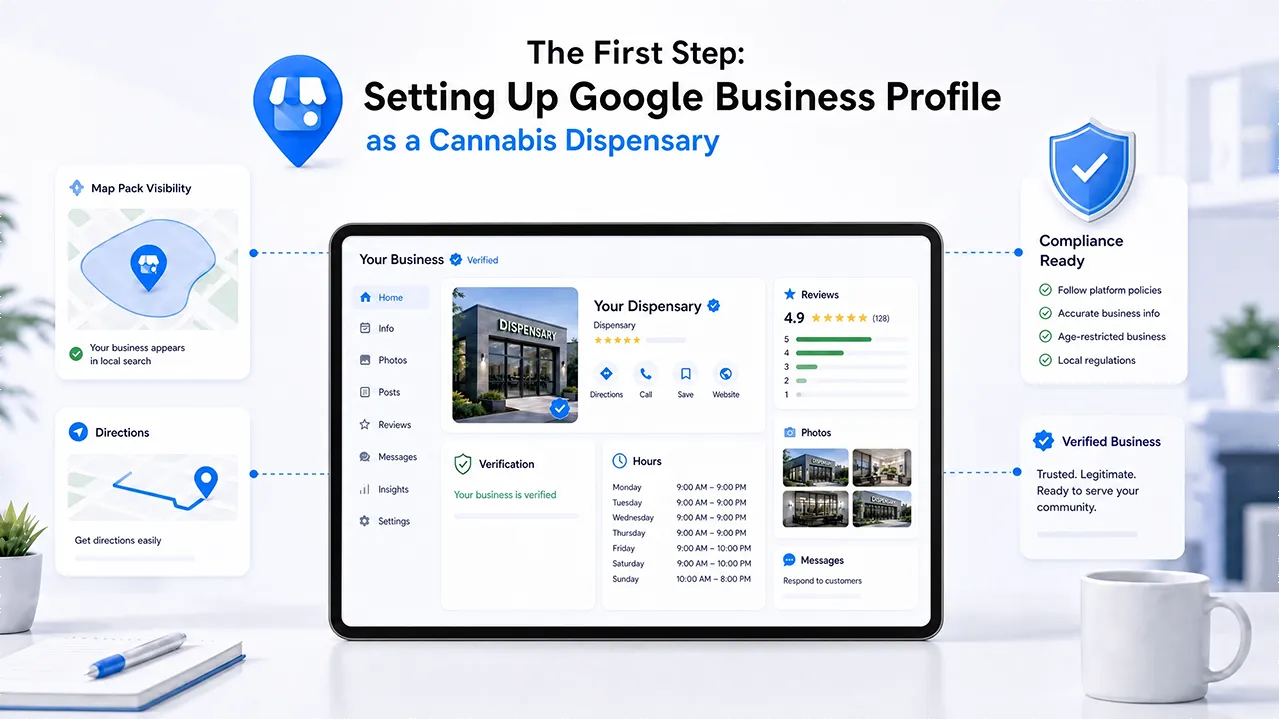
The most powerful tool when it comes to local SEO (and in fact, SEO in general) is also the easiest to set up, and it offers some astounding results.
Google Business Profile gives you access to Maps searches, appearing in the “Places” section of local searches, helps you stand out to AIs, and allows your customers to leave reviews. In fact, those who leverage their profiles well and appear in the Map Pack (the top 3 results) can often get up to 93% more interactions than those who rank lower. They also command about 43% of all search engine clicks.
It’s fair to say that your GBP plays a huge role in all your local SEO efforts, and getting it up and running only takes a few minutes. Getting the most out of it and having it really do the heavy lifting for your local SEO takes a little more thought and effort.
It’s also a fantastic way of directly engaging with your customers. They can leave reviews, and you can respond to them, either thanking them for the positive rating or addressing their concerns. This allows your profile to stand out to people who stumble across you in their search results.
Setting up your GBP is very simple; just claim your profile and verify that you’re the owner (either by phone, post, or email), and you’ll have taken the first steps. From here, we can start building out the content to make your profile really stand out.
How Does Google Business Profile Rank Your Business?
While we tend to talk about “ranking” when discussing the order that search engines and similar tools present their results, it’s a bit of a misnomer when it comes to Google Business Profile. There is no single “top” spot, and instead, results are generated dynamically based on three criteria:
- Proximity: Where the search was carried out
- Relevance: How closely your profile matches the search intent
- Prominence: How popular Google thinks your business is with similar searchers
We don’t have much control over proximity, but we can influence or outright control our other criteria through optimizing your profile to stand out to customers, AIs, and Search Engines alike.
Extra Steps for Cannabis Dispensaries
Of course, it goes without saying that Google defers to local regulations where appropriate. It's crucial to ensure that all your efforts stay within the letter and spirit of the law in your area.
While every business has to go through the verification process (you wouldn’t want someone else running your profile after all), this can sometimes be a little more complex for businesses in the cannabis sector.
The exception to this rule is businesses which focus on CBD oil products over THC-based ones. Google generally considers these to be Health and Wellness products, so while they're still under stricter regulation than many things, they have a bit more freedom when it comes to how Google Business Profile can be used.
As the legal landscape around supplying cannabis for recreational or medicinal purposes is patchwork at best, Google often protect themselves by requiring a more in-depth verification process.
The photos that you select, and which features (notably “offers” and ”posts”) you can use, are limited when compared to those of another business.
If your initial attempt to verify your business profile fails, get in touch with Google support and explain that you’re operating a legally licensed business, and they should ensure that your profile is claimed.
We’ll also have to be careful when it comes to the nature of our profile content- Google classifies cannabis as a “dangerous product or service”, which places some pretty heavy restrictions on what we can do to market your dispensary.
What Should My Google Business Profile Contain?
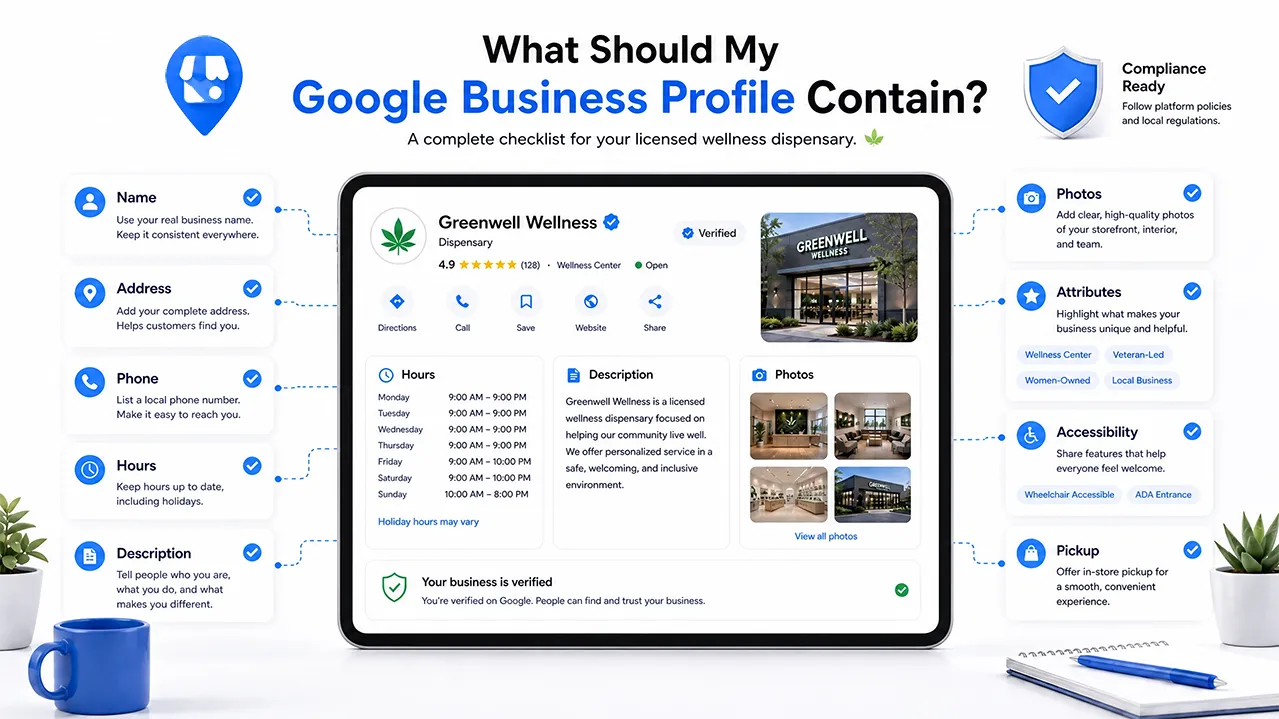
As a general rule, the more complete your Google Business Profile is, the more likely it is to rank well. This basically means that you should fill out the forms as completely as possible, but it’s worth paying close attention to:
- Contact Details: Your NAP (name, address, phone number) should match everywhere it’s listed to avoid confusion.
- Business Description: You have 750 characters to tell people what you do. Include your local area, services you offer, and the most popular brands your customers can get from you.
- Business Hours: this is pretty self-explanatory- people searching want to know when you’re open. Like your NAP, make sure you’re always consistent to avoid confusion.
- Photos: Pictures of your premises, non-drug-related stock, and anything else relevant- the more the better. In fact, profiles with 100+ images get around 520% more calls and 2717% more requests for directions than those without.
- Attributes: Things like whether your premises are wheelchair accessible, whether you offer curbside collections, or even if there’s a parking lot outside, can make a difference.
Picking Photos For Your Google Business Profile
Companies that operate around products that Google deems to be “dangerous”, such as cannabis, face much stricter rules around which images they can and can’t post to their profile. While you generally want to have as many high-quality images as possible, the nature of the pictures really does matter.
Drug paraphernalia like pipes, papers, and bongs will likely trigger penalties, and photos of the cannabis or gummies themselves are entirely out of the question. This means that we have to focus on things like the premises, staff members, non-directly drug-related products, and other less risky pictures.
Do I Need a Separate GBP for Each Location?
If you run multiple outlets in the same jurisdiction, you can list them all from a single account. Using your dashboard, set up a location group and add each location individually, including any location-specific information, but keeping the general format the same.
This allows you to monitor your results for each profile and means that you can take the best advantage of the proximity ranking criteria.
Dealing With Proximity
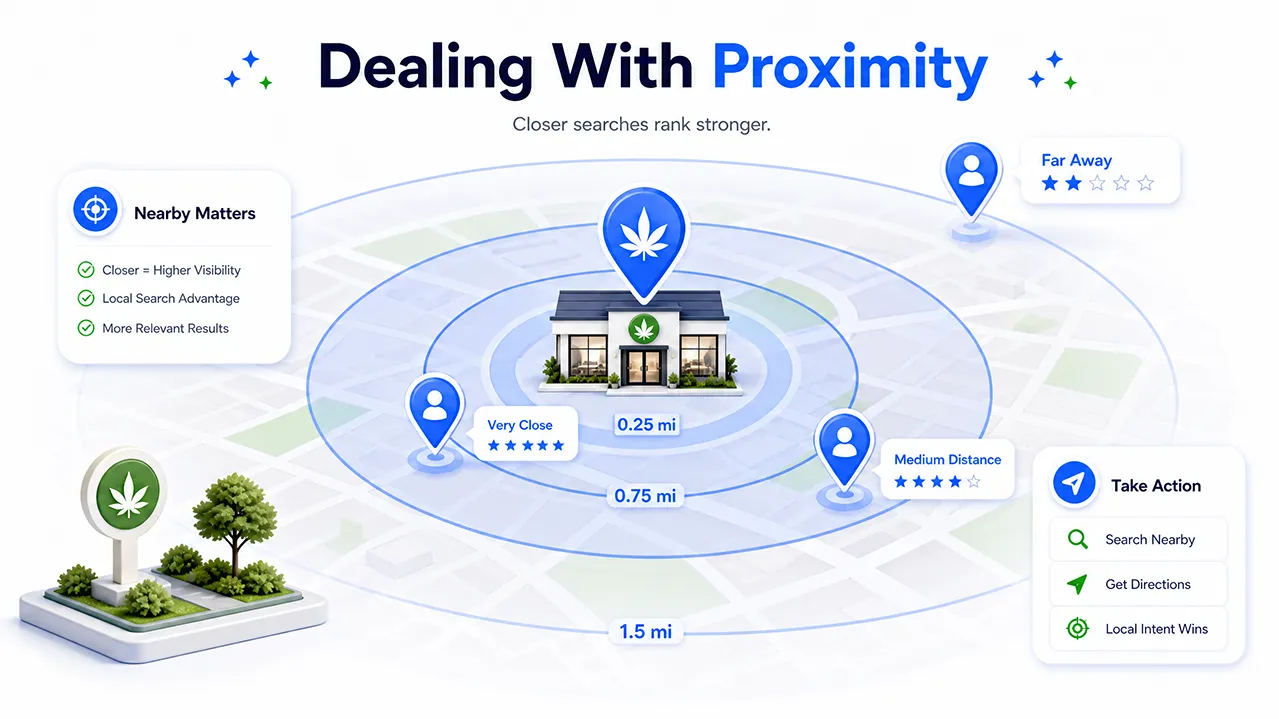
One of the biggest ways that Maps searches and local SEO diverges from normal SEO is the huge role that proximity plays in determining search result rankings. Generally, people want to find a location that’s fairly close to them, so Google places a premium on distance and travel time.
Now, obviously, we can’t control where our customers are searching from, but we can still influence which searches we appear in. There are two ways we can do this: service area settings and localizing our profile content.
Setting Up Service Areas
Service areas are, unsurprisingly, the areas that we’re targeting searches from. While it’s tempting to just park a pin on our location and leave it at that, your GBP allows you to set up to 20 service areas, and you should make use of this feature.
While simply setting up your profile with your address will allow you to appear in searches, setting specific service areas targeting the surrounding neighborhoods can really help improve your visibility.
Think about where your customers come from rather than simply where you want them to go. The main concern is that these areas should be as specific as possible and shouldn’t overlap. Use ‘hard’ data like postal codes to set up your target areas.
Localizing Your Content
While it doesn’t directly impact your proximity metric, targeting your local area via your business description can help you appear in certain location-based searches. This is always helpful, but it particularly stands out if you’re targeting visitors to the area.
Include things like your city, neighborhood, and street name in your business description, as well as your general profile.
Building Relevance
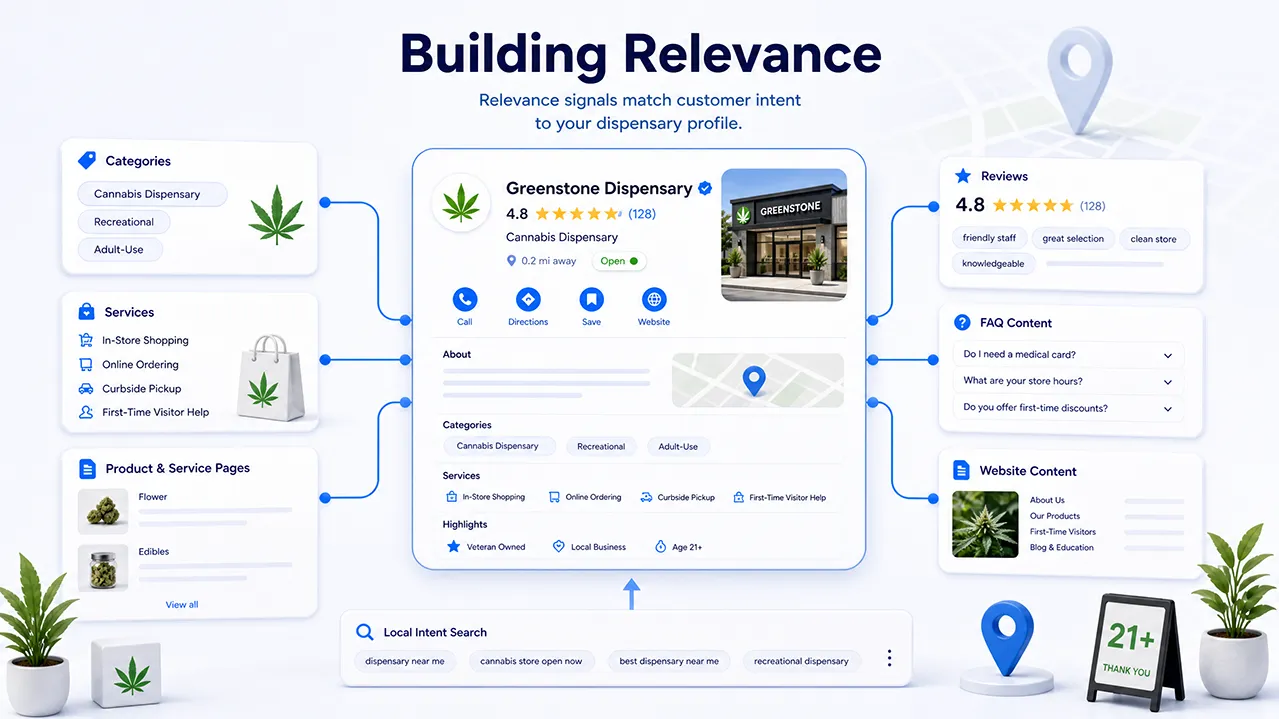
The aspect of how Google decides to serve up our profiles that we’ve got the most direct control over is relevance. This is the criteria that Google uses to decide whether your profile offers their searchers what they’re really looking for. It takes the content of your profile and the text of your reviews into account.
Choosing Categories
Think of Categories as the headlines of your Google Business Profile. These are the high-level groupings that tell Google exactly what you do and which search categories your profile is worth offering to.
There are two levels of category: Primary and secondary.
Primary Categories
The single most important choice when setting up your GBP is your primary category. This is the top-level “I do this” marker that sends the most powerful signal about relevance. When it comes to operating in the cannabis sector, there are some rules that we need to follow.
Firstly, we need to be as accurate as possible. Cannabis, though legal in many places, is still classed as a “Dangerous Product or Service” by Google, and that limits what we can and can’t do in terms of categories.
As a general rule, you should list your business as a “Cannabis Store” if your main business is offering cannabis and THC products for recreational use. If your customers have prescriptions or you offer medical consultations, the correct category is “Medical Marijuana Dispensary”.
Secondary Categories
Secondary Categories allow you to get a little bit more detailed. These might include things like “delivery service” if your local area allows direct deliveries or “Alternative Medicine” if you offer therapeutic services.
As Google’s rules around advertising cannabis are pretty restrictive, you’re limited in which secondary categories you can use. Generally, you should be extra careful not to fall foul of Google’s representation policies.
Writing Your Business Description
Your business description is your chance to really sell your business and build a little relevance straight off the bat. It can be up to 750 characters long, so you have a little room to play, but it’s still important to keep it focused and avoid reading as “spammy”.
Because we’re limited in the promotional tools that we can use when marketing a cannabis dispensary, your description is even more important than it would be for any other business. Make sure that you include:
- What you offer - if you focus on medical cannabis, mention it. If you offer curbside collections, this is the place to tell people. Got the world’s biggest selection of bongs? Let them know!
- Where you are- location, location, location. This isn’t your only tool for influencing relevance and proximity, but it’s a powerful place to reinforce your local standing.
- What makes you unique- focus on the atmosphere you’ve built in your dispensary, how big your range is, and anything else that makes you stand out.
- Compliance - it’s important to hammer home your dedication to staying within the rules.
- Your focus on the customer- customer service is always key.
Your description should be keyword-rich- including the terms that people are likely to be searching for- but avoid the temptation of coming across as spammy. People are always your primary audience, and if Google suspects you’re trying to game the system, they might delist you entirely.
Reviews
Reviews play three roles in your Google Business profile. Firstly, people really do read them- 96% of searchers make use of a profile’s reviews before making contact- and they’re often your first chance to make an impression. They also help build prominence, which we’ll cover in the next section.
In terms of building relevance, reviews are a great source of keywords. If someone leaves a glowing recommendation of your services, naming them directly, Google reads that as a signal of relevance. You can (and should) also reply to each and every one, as this allows you to squeeze in a few more relevant keywords, further heightening your relevance for your target searches.
Building Prominence
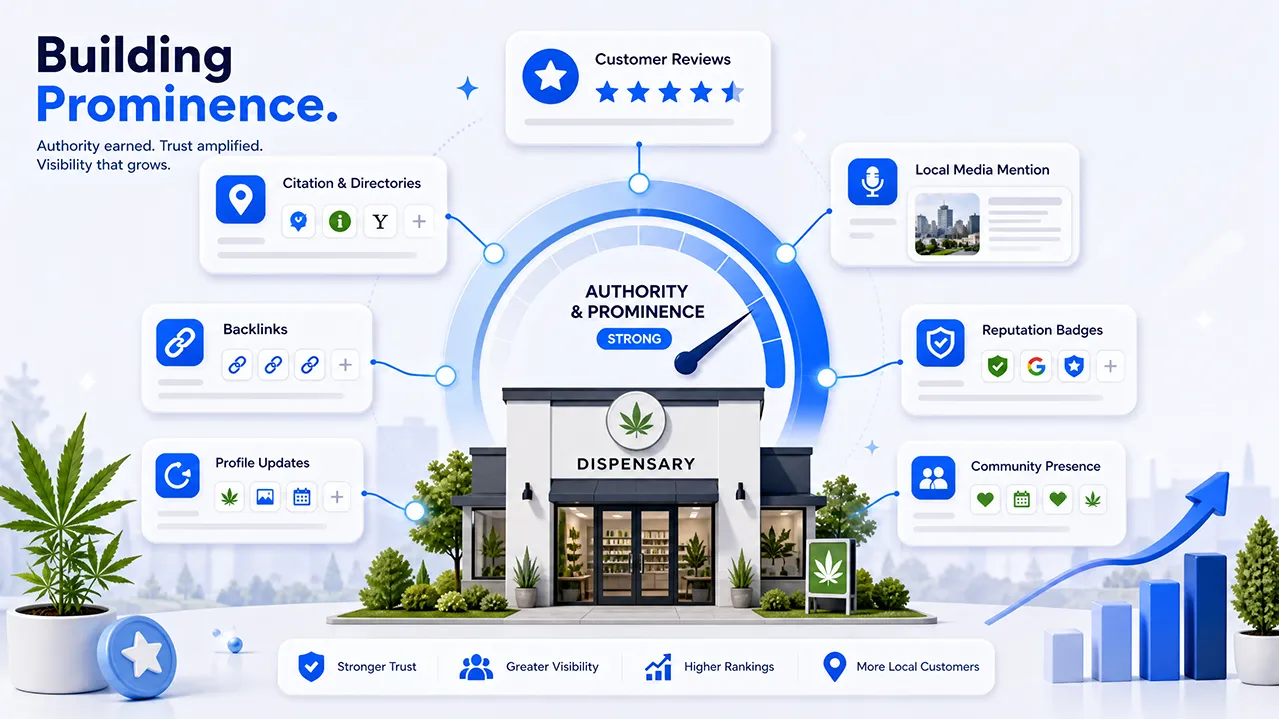
The final ranking metric that your Google Business Profile relies on is prominence. Think of this as a rough measure of how popular your business is. There are no shortcuts here (and be wary of those who offer them- ranking penalties are no joke, especially for businesses like cannabis sales).
Our main weapon here is going to be reviews, but how active your profile is, how long you’ve been listed, and how you appear elsewhere online will all play a role, too.
Reviews for Prominence
The simplest way to build prominence is to actually ask your customers to leave reviews. Include a request on receipts, ask them in person, or send out follow-up emails. A slow, steady build-up of reviews over the course of months or years is the aim here; too many too quickly will seem suspicious and likely trigger penalties like stopping customers from leaving reviews at all.
Generally, the more good reviews (4-star plus) that a business has, the more prominent Google will judge them to be and the better they will rank.
Listing Elsewhere
How your business appears outside of your Google Business Profile also plays a role in determining your prominence. Obviously, your own website, if you have one, is a great place to reinforce your popularity and location, but where and how you list yourself on other sites matters too.
These listings should focus on locality- local business directories, licensing boards, and local media are all great places to reinforce your credentials and build prominence. They’ll also offer you a handy way of getting a high-quality, locality-reinforcing backlink for your on-site SEO efforts, too.
The most important thing to think about here is ensuring that your NAP is consistent. That means if you’ve listed your address as Unit 1b, 123 Fake Street, it must always be listed as “Unit 1b”. Even small deviations like just “1b” or “Ground Floor Left” can create confusion and waste your efforts.
Staying Active
Google places a premium on actively managed profiles, so logging into your dashboard regularly and staying active is important. The simplest ways of demonstrating that your profile hasn’t been abandoned are:
- Regularly confirming your opening hours: it doesn’t matter if nothing has changed; simply logging in and confirming your hours regularly will mark your profile as active. This should be done at least once a month, though some businesses do it weekly.
- Responding to reviews: whether they’re good or bad, every single review needs a response. This signals to Google (and your potential customers) that you’re active and dedicated to offering a great experience.
While other businesses can use features like posts and promotions to stay active, these doors are closed to us thanks to the Dangerous Products and Services policy.
How Does AI Use Your Google Business Profile?
In the age of AI search (which, thanks to Google’s new search bar and the rise of AI chatbots, is here now), Google Business Profiles are about more than just appearing in the Map Pack. They’re a primary source of information that allows AI to present a confident answer to questions like “where can I fill my medical cannabis prescription?” or “are there any good dispensaries that offer delivery near me?”.
All aspects of your profile are taken into account, but things like photos, reviews, opening hours, and other verifiable parts are the most important. These allow the AI to offer a quick and easy answer to its users’ questions. With 60% of users claiming that they get everything they need from a simple search summary, it’s vital that you target these.
Unfortunately, most AIs can only pull information from about 5-8 sources, so optimizing your profile here is absolutely critical. Some businesses have more options than we do, but through carefully crafting your description and responding to reviews, there’s still a lot we can do.
The most relevant way to get mentioned as a cannabis-based business directly from your profile is through your reviews. “Friendly staff”, “great knowledge”, or “fantastic range” are all common things to see on AI summaries. Court these responses!
We can also target AI mentions through our business description. We’ve only got a little bit of text to work with, but AI absolutely thrives on semantically linked wording. This means that you should vary your phrasing to help give the bots a better sense of what it is you actually offer.
Unfortunately, the other options are closed to us, thanks to Google Business Profile’s Dangerous Products policy, so we can’t use posts or the “products” section to illicit AI attention.
Listing Locally
The other relevant thing we can do to boost our local SEO results without setting up a dedicated website is make use of local directories. These help in a couple of ways:
- They provide a ‘citation’, marking your business out as a real entity and proving your existence in the local community.
- If you do have a website, they offer a great back link, helping you to build authority.
- They can drive a surprising amount of traffic your way directly.
Simply being mentioned on these digital phonebooks is enough for Google and various AIs to take notice and start directing traffic your way. That being said, it's vital that your NAP is consistent across every single listing to avoid confusing your customers, the search engines and AIs.
Common Problems For Cannabis-Based Businesses With Local SEO
While getting your Google Business Profile up and running gives you a powerful tool for gaining local attention, it’s not without its risks and problems. None of them is insurmountable, but they do take a little careful navigation.
The first and most awkward problem is that some of what makes Google Business Profile such a useful tool is simply unavailable for cannabis stores. Strict rules around business profiles that deal with things Google deems to be dangerous mean that we can’t use promotions or posts to build relevance and prominence like other businesses might.
We can get around this by courting positive reviews and focusing on our business information, including things like facilities and other relevant attributes. While you can’t directly promote your THC-based products, you can still sell the experience.
Secondly, this same set of policies often ends up with cannabis-based businesses being penalized or delisted, even when they’re fully legal in their location. This requires very careful adherence to both Google’s policies and local laws around marketing cannabis products. If in doubt, always err on the side of caution.
Conclusion: Why Cannabis Dispensaries and Businesses Should Think Local
Put simply, your customers are contained within a given geographic location, and local searches are the best way to target them. You might face stricter rules than some businesses do, but there are no digital marketing channels that can compete in terms of local targeting and reach that aren’t under the same auspices.
Google Business Profile is free, powerful, and relatively simple to set up, and, combined with traditional SEO efforts like blogging and backlinks campaigns, can net you a lot of traffic.
